Enterprise Go-to-Market Strategy Case Study
$13.7M Upside, 36% Lower Cost

Executive Summary
A private equity-backed global iPaaS provider had scaled a large sales force on SMB and mid-market demand but was falling short in Enterprise, its primary growth mandate. One-third of the sales team had no new-logo wins in the prior 12 months. Blue Ridge Partners assessed the commercial organization and redesigned its enterprise go-to-market strategy: hunter and farmer roles in customer-centric pods, account prioritization, a graduated compensation curve and a playbook for the new roles. The new model was sized to deliver $13.7M (+30%) of additional Enterprise revenue at a 36% lower sales cost, with modeled LTV:CAC improving from 1.33 to 2.70.
Client Background
Why was enterprise growth the mandate for this iPaaS leader?
The client is a global, cloud-based integration platform as a service (iPaaS) provider backed by a private equity sponsor. Nascent demand drove rapid growth in the SMB and mid-market segments, and the company scaled its sales force to take orders from buyers who were already looking for a solution.
Enterprise had become the primary growth mandate. Selling to large enterprises calls for a different sales coverage model: targeted prospecting, more strategic deals and deliberate account expansion after the first sale. The existing organization had been built for a different job, and the result was a large, costly sales organization whose structure and incentives had not kept pace with the segment the company most needed to win.
The Challenge
What was holding back enterprise go-to-market performance?
Sellers were working in a reactive, order-taking mode. Less than 10% of account executive time was customer-facing, and one-third of the sales team had no new-logo wins in the prior 12 months. With little segmentation or account prioritization, prospecting was scattershot and deals were smaller and less strategic than the Enterprise segment required.
The coverage model compounded the problem. There was no clear distinction between hunters and farmers, and overlapping support, service and technical roles confused customers and diluted focus.
Compensation was not driving the right behaviors either. Plans were spread too evenly across the team and did not adjust for natural account growth. The ratio of customer lifetime value to land-and-expand cost stood at 1.8x against a target of 3.0x.
The central question: what operating model, roles and incentives would let a sales organization built to take orders win and grow Enterprise accounts at a lower cost of sales?
The Diagnosis
What did the assessment reveal about enterprise selling?
Blue Ridge Partners assessed the current sales organization across how sellers spent their time, new-logo productivity, coverage and role design, account targeting and compensation. Four findings stood out.
- Selling time was misdirected. Sellers spent significant time on prospecting, yet less than 10% of account executive time was customer-facing.
- New-logo results were uneven. One-third of the team had no new-logo wins in the prior 12 months, and limited prioritization and targeting led to faster, smaller, less strategic deals.
- Roles overlapped. Support, service and technical roles blurred together, creating customer confusion and loss of customer focus, and there was no defined hunter and farmer split.
- Compensation was a weak behavioral lever. Pay was distributed too evenly, and targets did not reflect expected natural account growth, which left the ratio of lifetime value to land-and-expand cost at 1.8x versus a 3.0x target.
The critical insight: time, roles, targeting and incentives were all reinforcing the order-taking behavior the company had needed in SMB and mid-market. A seller on an evenly weighted plan, with unclear role boundaries and no list of priority accounts, will rationally default to the orders that arrive, and that is the behavior the organization was producing. Enterprise success required redesigning these elements together, not adjusting any one of them.
The Solution
What did Blue Ridge Partners recommend to fix enterprise selling?
Blue Ridge Partners defined a new Enterprise go-to-market model built on five initiatives.
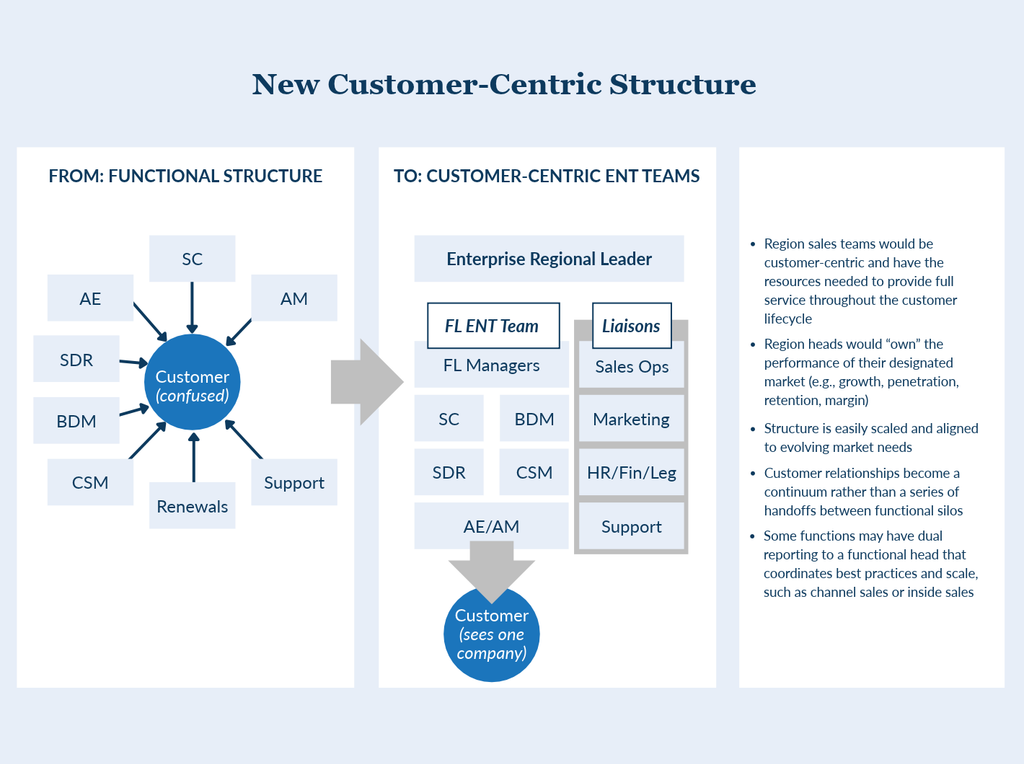
- Hunter and farmer roles in customer-centric pods. The objective was to give every seller a clear job and replace functional silos that had confused buyers. Account executives (hunters) and account managers (farmers) were aligned to cross-functional pods with clear penetration targets and productivity expectations benchmarked to the SaaS industry. The pod design promotes shared goals, teamwork and joint account planning. The expected impact was greater focus on new logos and on growth within existing accounts.
- Account prioritization. The objective was to replace self-directed prospecting with a company-directed motion. Data-driven segmentation identified the highest-potential Enterprise accounts, and an analytical scoring model focused sellers on the most strategic opportunities. The expected impact was larger, more strategic deals.
- Graduated “hockey-stick” compensation. The objective was to build a high-performance sales culture. The new curve rewarded top performers disproportionately and adjusted targets for natural account growth, moving the ratio of lifetime value to land-and-expand cost from 1.8x toward the 3.0x target.
- Lead-to-order redesign. The objective was to align Marketing and Sales. SDRs and BDMs were redeployed to increase customer-facing time and reduce administrative prospecting, and business development resources were better leveraged. The expected impact was more selling time with customers and tighter alignment between Marketing and Sales.
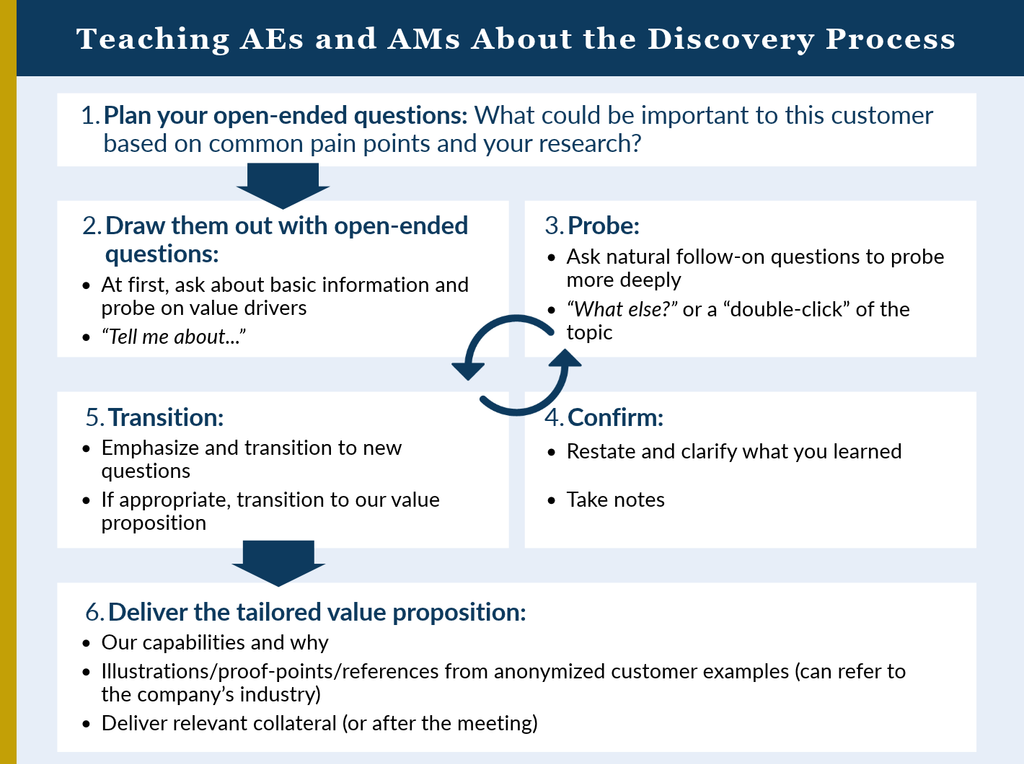
- Playbook and Field Guide. The objective was consistent execution of the new model. A single playbook covered the full land-and-expand cycle, supported by a shorter field guide for the most critical tasks. The playbook spans ideal customer profile targeting, discovery, value proposition, deal progression and post-close expansion, and was designed to accelerate onboarding and improve deal consistency.
The Execution
How did the new model translate into day-to-day selling?
The work moved through three stages, each building on the last.
Stage one was the assessment. The team documented how time was spent, where roles overlapped and why compensation was failing to drive behavior, establishing the baseline the new model would be measured against. Findings from the assessment fed directly into the design, so each element of the new model answered a specific problem the team had observed.
Stage two focused on designing the Enterprise model. This defined the commercial operating model and coverage required to deliver the revenue and cost targets: hunter and farmer roles within pods, the account prioritization approach, the graduated compensation curve and the redesigned lead-to-order process.
Stage three turned the design into working tools for the field. The client was transitioning to a hunter and farmer model in which existing account executives would be designated as either hunters or farmers, and it asked Blue Ridge Partners to codify the earlier recommendations in playbooks. The team interviewed 11 leaders across sales, marketing, customer success, sales development, partnerships, pricing, compliance and enablement.
Two decisions shaped the result. Hunter and farmer roles depended so heavily on each other that the client and Blue Ridge Partners consolidated two playbooks into one, so both roles could see their contribution to the land-and-expand motion. And, based on input from the incoming Chief Revenue Officer, the team created an abridged field guide as a reference for the most critical tasks in advancing sales opportunities.
The playbook covers ideal customer profile targeting, discovery, value proposition, deal progression and post-close expansion.
The Results
What enterprise value did the new GTM model unlock?
Before the engagement, less than 10% of account executive time was customer-facing, one-third of the team had no new-logo wins in the prior 12 months, and the ratio of lifetime value to land-and-expand cost was 1.8x against a 3.0x target.
Financial impact: the new operating model and coverage were sized to deliver $13.7M (+30%) of additional Enterprise revenue at $28.1M (36%) lower sales cost. LTV:CAC was modeled to improve from 1.33 to 2.70.
Operational impact: the client expects faster onboarding of new account executives and account managers, and faster transition of existing account executives into their new roles. Better sales performance is expected in the form of larger average deal size, higher win rates and greater expansion after the initial sale, along with more consistent, predictable revenue forecasts and pipeline requirements.
How results were measured: the revenue, cost and LTV:CAC figures are modeled outcomes of the designed operating model and coverage, and the operational benefits are expected outcomes rather than realized results.
How was the sales team equipped to sustain the gains?
The new model gave the organization permanent structures rather than a one-time fix. Pods with clear penetration targets and productivity expectations benchmarked to the SaaS industry set a standard for performance, and the graduated compensation curve reinforces it.
The playbook and field guide codify how sellers should work and accelerate onboarding, so the model does not depend on individual know-how. The account scoring model keeps targeting company-directed, and the redesigned lead-to-order process keeps Marketing and Sales working to shared goals.
Clear role definitions and consistent deal progression also make forecasts and pipeline requirements more predictable, giving leadership a way to monitor progress. The next opportunity is deeper expansion after the first sale, the part of the land-and-expand cycle where farmers now have a defined role.
Is your sales organization built for the segment you want to win?
Companies that scale quickly on inbound demand often carry a sales organization built to take orders. When the growth mandate shifts to larger, more complex accounts, the same structure can hold performance back.
In this case, the answer was not more sellers. It was clearer roles, better targeting, incentives that reward the right behaviors and tools that make the new model repeatable. Together, they were sized to deliver more revenue at a lower cost of sales.
Leaders can start by asking three questions. How much seller time is spent with customers? How evenly are new-logo wins distributed across the team? Does compensation reward growth in the accounts that matter most?
If you are rethinking your enterprise go-to-market strategy, contact Blue Ridge Partners to discuss where your commercial model may be leaving value on the table.