
Commercial organizations often have a gap between what their strategy assumes and what the revenue engine delivers. This results in missed targets, underperforming sales teams, and weak financial results, which compounds quarter after quarter. Blue Ridge Partners offers commercial excellence consulting services to Fortune 1000 companies and PE-backed portfolio companies. We diagnose, prioritize and implement the highest-impact changes with the metrics in place to measure progress. Our PowerPoint-to-Cash approach helps turn recommendations into results.
Our Sales and Marketing Consulting Approach
Blue Ridge Partners has worked with more than 1,300 companies to improve commercial performance. Before making recommendations, we quantify leakages in time, pipeline and margin that sap results. Our diagnosis draws on CRM data, time studies, compensation analysis and structured interviews across sales, marketing and leadership. We also interview customers, former customers, experts, and others outside the company to form an outside-in perspective on the company’s performance in the market v.v. competitors (The Nine Voices of the MarketTM). The insights from this 360-degree diagnosis, combined with our pattern recognition from 1,300 projects, lead to recommendations on which levers to pull to drive growth, in what sequence, and how to sustain results after the engagement ends.
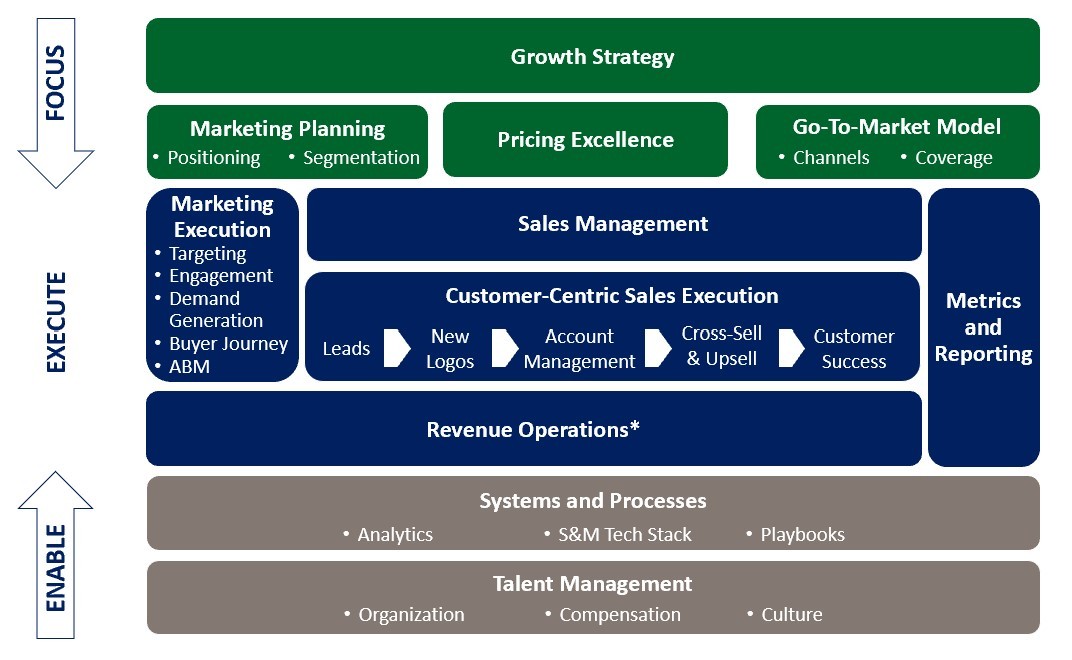
Our commercial excellence consulting spans seven interconnected disciplines:

Lead Generation and Demand Creation
Our experts develop predictive targeting models and ensure the sales and marketing relationship is aligned around a shared view of ideal customer profiles and value propositions. We also help improve the performance of the demand generation programs, both inbound and outbound, so that the top of the funnel fills with high-probability opportunities.

Grow Existing Accounts
We help design account management processes that are built around maximizing the penetration of available white space and capturing lifetime value rather than historical results. These include developing segmented account planning and QBR processes, designing cross-sell programs and upsell motions and sales plays, and structuring Customer Success roles that protect and grow relationships. Expansion revenue, retention, lifetime value, and NPS are used to track progress.

Salesforce Productivity and Enablement
A number of factors influence sales productivity, including targeting and lead flow, sales management effectiveness, and sales enablement. But one of the most important is time spent with customers – we often work with clients whose reps spend less than a third of their time with customers – less than half of what a high performing sales team expects. We survey the sales team to understand where the leakage is and then redesign processes and tools to help minimize administrative drag, identify best practices and behaviors, and propagate them throughout the organization using standard sales playbooks, build onboarding programs that get new sellers to full productivity faster, and help make sure salespeople are not wasting time finding and chasing unqualified leads. We also work to identify “quick wins” that can generate positive revenue traction and start “moving the needle”

Sales Compensation and Incentive Design
Our team assesses compensation plans for commercial roles against eight core design principles and identifies where the plans fall short. We then redesign pay mix, quota-setting methodology and plan mechanics, and model the cost and behavioral impact of proposed changes with the objective of aligning compensation with desired behaviors. We then help with the back-testing, communications, and rollout activities needed to successfully transition the plans.

Revenue Operations and Systems
We are frequently asked to stand up a new Revenue Operations function or tune up the charter and activities of an existing RevOps team to achieve greater impact on revenue growth. Important elements are CRM structure and data discipline, pipeline and forecasting rigor, standardized KPIs and dashboards, and the reporting cadence that keeps leadership and the field working from the same numbers. Equally important is the enablement of the sales team – making sellers as productive as possible through tools, playbooks, data, and customer insights.

Go-to-Market Organization and Channel Design
Our experts assess coverage, channels, skill sets, and commercial structure against the segmented market opportunities. We then redesign coverage models that align the right resources with the ideal customer profiles of each segment, considering all the relevant channel alternatives – direct, partners, resellers, distributors, virtual sales, self-service, etc. We also build or refine channel programs and deliver a sequenced transition plan that is pragmatic about the team’s ability to absorb change yet is disciplined about making measurable progress in “moving the needle” on results.

Commercial Excellence Consulting Results
Our diagnostic-first approach surfaces performance gaps that internal teams have learned to work around. The following three engagements illustrate what that diagnosis finds and what changes when teams act on it:
- For a global enterprise software company, a time-allocation study revealed that sellers spent only 23% of their time on customer-facing activity. Our recommendations doubled effective selling time and lifted overall sales productivity by 70% after the first year.
- We performed a comprehensive commercial assessment for a logistics services provider, redesigned the sales process and rebuilt an incentive compensation plan. The result was new-logo growth that was 20% above budget and a $1 million increase in monthly gross margin.
- For a global industrial manufacturer, a win-rate diagnostic revealed the company’s win rate was roughly 10% against a 27% industry benchmark for new business quotes. Our commercial effectiveness recommendations resulted in more than $1.6 billion in opportunity within the top 50 customers alone that was closed at a rate roughly the same as the industry norm.
Ready to Strengthen Your Commercial Organization?
When execution falls short of what the strategy assumes, the cost compounds. Let’s talk today about where that gap exists in your organization and what closing it would be worth.
Frequently Asked Questions
Growth Strategy focuses on where to compete – market selection, product and service focus, and adjacency opportunities beyond the core business. Commercial Excellence focuses on how well the organization executes day to day once that direction is set: sales management, productivity, account growth, compensation, and operations. The two are complementary rather than competing – many engagements combine both when a company needs to decide where to grow and rebuild the execution engine to get there – but Commercial Excellence can stand on its own when the strategy is sound and execution is the primary gap.
No. Most engagements begin with a focused diagnostic that identifies the two or three areas most likely to produce measurable near-term impact, then sequences the remaining areas based on priority, dependency between initiatives, and the organization’s realistic capacity to absorb change. Trying to fix all seven simultaneously typically overwhelms front-line management and undermines adoption, so BRP builds a phased roadmap with clear ownership and milestones for each stage rather than launching every workstream on day one.
No. Sales training addresses individual skills and knowledge. Commercial Excellence addresses the management systems, incentives, processes, and organizational structure that determine whether those skills actually translate into results in the field – and whether any improvement lasts once training ends. A rep trained on a new selling technique inside a compensation plan or management cadence that rewards different behavior will typically revert within a quarter; BRP’s work is designed to change the system around the seller, not just the seller.
Where it adds clear value, yes – for example, in predictive lead targeting, account propensity modeling, or churn prediction that sharpens where sales and marketing focus their time. But AI is a supporting tool within Commercial Excellence work, not its foundation. The core of every engagement remains disciplined diagnosis, management systems, incentive design, and process – capabilities that hold up regardless of which specific tools or technology a company deploys around them.
BRP’s Commercial Excellence practice primarily serves companies with $100 million or more in annual revenue, including private equity-backed portfolio companies operating within a defined hold period. At this scale, commercial organizations are typically large and complex enough that gaps in sales management, compensation design, or revenue operations create material, measurable drag on growth and margin – and disciplined enough in their data to support a rigorous, evidence-based diagnostic.
Diagnostics typically run several weeks, combining data analysis with structured interviews across the commercial organization. Implementation support varies considerably by scope – a focused initiative such as compensation plan redesign may conclude within a quarter, while a broader program spanning several of the seven Commercial Excellence areas, with piloting and phased rollout, often runs multiple quarters. BRP scopes each engagement to the specific levers identified in the diagnostic rather than applying a fixed timeline to every situation.
Every engagement establishes baseline metrics specific to the areas addressed – selling time allocation, pipeline conversion rates, account penetration and expansion revenue, compensation plan performance against the design principles, or forecast accuracy – before any changes are made. Progress is then tracked against that specific baseline throughout implementation, with dashboards and reporting cadence built as part of the engagement so leadership can see results directly rather than relying on anecdotal feedback.
Yes. Many Commercial Excellence engagements are sponsored directly by private equity firms evaluating or managing a portfolio company, particularly where commercial performance is a key value creation lever within the hold period. BRP’s diagnostic approach, emphasis on near-term measurable impact, and comfort reporting results to a board or investment committee are well suited to the pace and accountability PE sponsors typically require of an operating partner.