
Most leadership teams can list a dozen ways to grow, but investors and boards want to know which few will actually move revenue and EBITDA – and whether that growth lives inside the core, in a core extension, or in a genuine adjacency. We build a defensible growth strategy grounded in market facts, capability assessment, and financial rigor, whether the fastest path runs through your existing business or beyond it.
A Fact-Based B2B Growth Strategy Built to Execute
Growth plans built on opinion rarely convert into revenue. For PE-backed companies and Fortune 1000 leadership teams, the stakes are higher. Boards demand a credible multiyear plan with financial backing and clear ownership. The structural mistake that companies make is pursuing adjacencies when the core may still hold meaningful, lower-risk growth.
Blue Ridge Partners builds growth strategy on our proprietary Revenue Equation™ framework, which decomposes revenue into its controllable components and pinpoints exactly where performance is being created, constrained, or lost. We start by mapping the full spectrum of where growth can come from: the core business itself, core extensions that vary from the core on a single dimension and can typically be pursued organically, adjacencies that require improving more than one core capability at once and typically need a partner or acquisition, and entirely new businesses that carry startup-level risk.
Our B2B Growth Strategy Consulting Approach
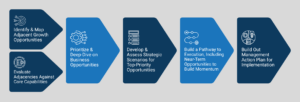
We follow a structured, evidence-driven process that moves from current-state diagnosis to a financially validated, board-ready growth plan – whether the fastest path to growth runs through the core, a core extension, or a genuine adjacency:
- Map the core, core extensions, and adjacencies: We analyze current performance to define the true core of the business, then map the full range of ways it could grow – core extensions that vary on one dimension, adjacencies that require multiple new capabilities, and new businesses – through leadership workshops that surface and screen candidate opportunities.
- Identify the core competencies to be leveraged: We build a competency map of the organization’s privileged assets – technology, customer relationships, channels, manufacturing capabilities, and brand – that could be leveraged into new opportunities, so every candidate is evaluated against what the company can realistically bring to it, not just what looks attractive on paper.
- Assess market opportunity and capability fit: Using our Nine Voices of the Market® methodology and our 100 Behaviors of High Performing Revenue Engines™ assessment, we score each candidate opportunity on market attractiveness and capability fit, then plot them on a prioritization matrix to separate the highest-potential paths from the rest.
- Develop and assess strategic scenarios: For the short list that survives prioritization, we build tangible evolutionary paths and vision alternatives – phased over several years, with the market and profit potential, required capabilities, and critical assumptions for each path clearly defined and pressure-tested with leadership.
- Build the execution and acceleration roadmap: For each prioritized path, we build revenue and EBITDA forecasts and a sequenced roadmap of required actions, distinguishing moves the organization can pursue organically from those that call for a partnership or acquisition, with candidate targets identified where relevant.
- Document and institutionalize the strategy: We synthesize the work into a documented multi-year growth strategy and management action plan the leadership team and board can act on, and establish a cadence for revisiting it as results, capabilities, and market conditions evolve.
Benefits of Our Growth Strategy Consulting Services
B2B growth consulting from Blue Ridge Partners gives Fortune 1000 leadership teams and PE sponsors:
- Confidence in where capital should flow, grounded in a common evidence base.
- A financially modeled, board-ready plan that holds up in investor diligence and supports stronger positioning at exit.
- Alignment across leadership on a single growth direction, so execution begins from shared conviction.
- The conviction to commit capital once the team has validated core capacity and adjacent market potential against real data.
A Growth Strategy That Delivers Results
Here are two engagements that illustrate our approach in practice:
- A cold-chain packaging manufacturer in a $486 million, 15%-growing market grew incremental revenue from $3.9 million to a projected $15.5 million by year three (a CAGR of 58%), after a segmentation-driven strategy re-positioned the company around underserved demand.
- A PE-backed specialty water treatment company, scattered across dozens of small, disconnected initiatives, used a structured opportunity assessment to identify $25 million in realistic U.S. revenue growth potential over three to four years.
- An industrial manufacturer of mezzanine and chute systems, highly profitable but exposed to a cyclical capital cycle, identified ten new business opportunities beyond its core, narrowing them through a market-attractiveness and capability-fit matrix to the single highest-priority opportunity for buildout ahead of a planned exit
Validate Growth Drivers and Capabilities
The company’s existing capabilities and market position are compared against the opportunities to provide a basis for assessing opportunity viability and setting initiative priorities as illustrated in the framework chart below.

Sometimes, the growth strategy effort highlights a gap between the future revenue aspirations and the revenue trajectory available in the core business. In such a case, the growth strategy may well include extending the core business into new areas—end markets, geographies, products/services, and/or new channels.
Ready to Build a Fact-Based Growth Strategy?
A growth plan is only as strong as the evidence behind it. Blue Ridge Partners helps CEOs, Fortune 1000 executives and PE sponsors define where growth will come from, whether inside the core, beyond it or both, and delivers the capability assessment, financial forecasts and implementation roadmap needed to make that plan credible in the boardroom and at exit.
Get in Touch Today
We bring extensive experience working with over 1,300 companies since 2002. Talk to a growth strategy consultant about what a fact-based growth strategy would look like for your business, and how quickly it could translate into a plan your leadership team can act on.
Frequently Asked Questions
Growth strategy answers where growth should come from – which markets, segments, products, or geographies to prioritize, and whether to focus inside the core or expand beyond it. Go-to-market and sales effectiveness work answers how to execute against that direction once it’s set. Most engagements start with growth strategy and flow into execution, but companies with a clear strategic direction can start directly with execution work.
We start by rigorously defining the core and testing, with real data, whether it still has meaningful untapped growth. If it does, that’s usually the lower-risk, higher-return place to focus first. If the core is genuinely saturated, or leadership specifically wants to understand adjacent options, we run a structured adjacency scan to identify and prioritize opportunities beyond it.
Adjacency scanning is our methodical approach to evaluating a wide slate of potentially attractive adjacent markets and narrowing them to the few worth pursuing in depth. We typically start with a broad hypothesis list, screen it using secondary research and agreed financial and strategic criteria, then run deeper primary research only on the top candidates – so effort concentrates on what matters rather than exhaustively researching every option.
Both, and we treat them as inseparable. A market opportunity is only real for a given company if it has, or can build, the capability to win it. Our internal capability assessment benchmarks talent, process, tools, and go-to-market readiness against each prioritized opportunity, so the resulting strategy reflects what the organization can actually execute.
Most of our growth strategy clients are $100 million or more in annual revenue, frequently private equity-backed or publicly held, across industrial, healthcare, business services, consumer, financial services, and technology sectors. Our approach scales to the complexity of the business, but the underlying discipline – core definition, market assessment, capability assessment, prioritization – stays consistent.
For each prioritized opportunity, we build a revenue and EBITDA forecast grounded in the market sizing and capability work already completed, along with the investment required and expected timing. This gives leadership and the board a financially specific case for each initiative rather than a qualitative recommendation, and a basis for sequencing investment across the plan.
Where it accelerates the work, yes – for example, using data and analytics tools to speed up market sizing, segmentation, or fact base development. But growth strategy is fundamentally a business and market judgment exercise. Technology supports the analysis; it doesn’t replace the strategic thinking, prioritization, and financial rigor that make the plan credible.
We typically recommend a light annual review to confirm the plan still reflects market conditions and results, with a more comprehensive refresh every three to five years or after a significant change – an acquisition, a new sponsor, or a material shift in the competitive landscape. Treating the strategy as a living plan rather than a one-time document keeps it useful.