Consumer Services Pricing Strategy Case Study
11% CAGR Improvement Over 3 Years

Executive Summary
A private equity-owned, high-value low-price company within the health and wellness industry needed a sharper pricing strategy. Complex, inconsistent membership tiers were limiting premium mix, digital conversion and in-location selling. In nine weeks, Blue Ridge Partners combined competitive benchmarking, member focus groups, elasticity modeling and conjoint research to redesign the price pack architecture, then built a pricing tool that lets franchisees adapt locally. The work identified an 11% CAGR improvement over three years, including $20M of corporate royalty revenue, while giving leadership a single, consistent pricing framework endorsed by the CEO and the franchisee network.
Client Background
How does a health and wellness chain grow revenue?
The client is a private equity-owned HVLP health and wellness chain operating more than 500 locations, a mix of company-owned and franchised locations. HVLP – high-value, low-price – is a crowded segment where brand strength, convenience and a clear entry price attract members, while premium tiers and add-on services drive profit.
The sponsor’s objective was to accelerate revenue and EBITDA growth by improving pricing architecture, consistency and execution across the existing locations and future developments. Demand for premium offerings was strong. Yet in a franchised network, corporate could shape pricing only through guidance, and each operator balanced brand consistency against local competitive intensity and member willingness to pay.
Leadership wanted a clear, fact-based answer in less than ten weeks.
The Challenge
Why was pricing strategy holding back growth?
Management believed that complexity and inconsistency in the membership tier structure were constraining growth in three places:
- Premium mix – strong demand for premium offerings was not converting into premium sales.
- Digital conversion – prospects faced a harder-to-read set of choices online.
- In-location selling – sales teams had difficulty selling value against key competitors.
For a chain of this size, small pricing gaps compound into large dollar gaps. Location-level discounting and under-priced ancillary services leaked revenue across hundreds of company-owned and franchised locations.
The central question: how could the company simplify and harmonize its membership tier pricing to lift premium mix and profitability, while still letting franchisees respond to local competition – and answer it in under ten weeks?
The stakes were higher because the sponsor’s growth plan depended on the answer. Every new location opened under an unclear architecture would carry the same pricing problems forward.
The Diagnosis
What did the pricing diagnostic reveal about the network?
Blue Ridge Partners ran a rapid, multi-method diagnostic rather than relying on any single lens. The team examined:
- Competitive pricing and offer benchmarks
- Member focus groups on value perceptions and unmet needs
- Price elasticity modeling
- A conjoint study of tier, amenity and price tradeoffs
- The current tier structure, including a three-tier versus simplified two-tier design
- Ancillary and online pricing communication
Key findings:
- Several core offerings were not positioned around what prospective members expected and were willing to pay for.
- R&R and elite studio offerings lagged consumer desires, which limited price-taking at mid and top tiers.
- Location-level discounting was eroding pricing integrity across the network.
- Other value-added services were under-monetized, and best practices were not shared across locations.
- Quick wins existed in processing fees and justifiable annual fee increases.
- New offerings, such as household discounts and loyalty programs, matched member needs the current structure did not address.
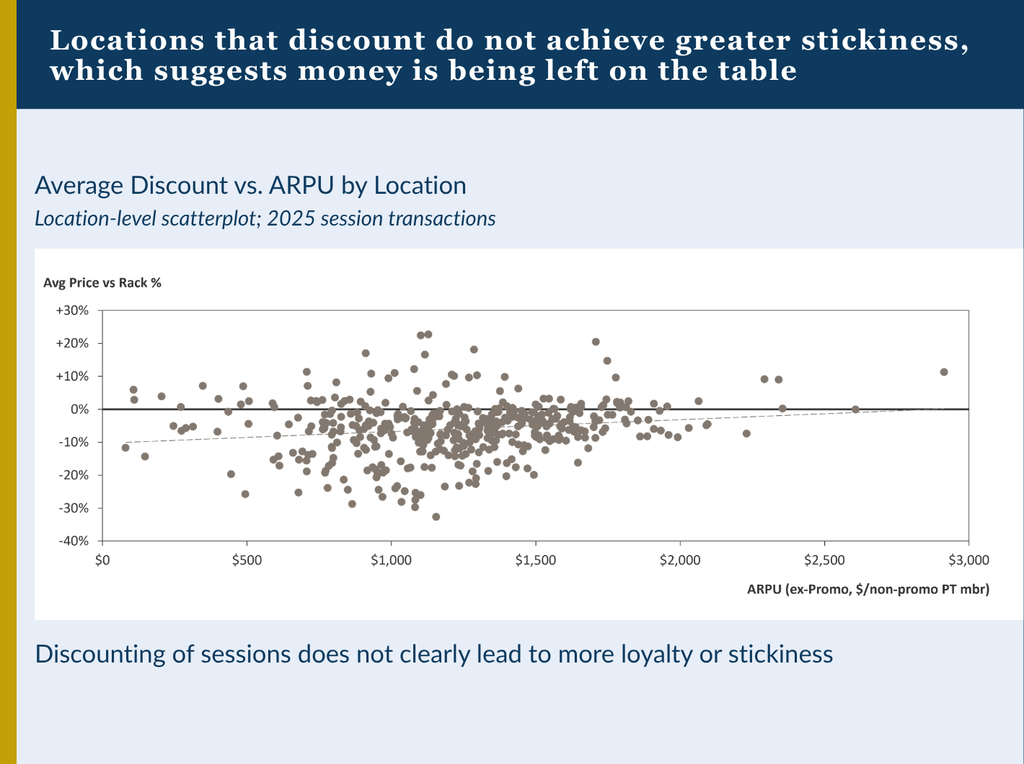
Taken together, the evidence pointed to a pricing problem of design and discipline, not of demand: members valued premium experiences, but the architecture and its execution did not capture that value.
The critical insight: simplicity and local flexibility are not opposing goals. A consistent architecture with clear guardrails can still let pricing flex by market, which is what a franchised network needs.
The Solution
What pricing recommendations did Blue Ridge Partners make?
Recommendations were organized around five priority areas, each tailored to a network that is both franchised and company-owned.
- Membership value architecture
- Objective: maximize enterprise revenue and profitability while preserving opening price points.
- Action: designed a new price pack architecture with amenity bundles by price and value tier, and evaluated three-tier versus simplified two-tier structures
- Impact: higher premium mix and a clearer offer for prospects.
- Pricing and guardrails
- Objective: protect price integrity.
- Action: built strategies to stop location-level rogue discounting, upgraded R&R and elite studio offerings to support price-taking, and identified household discount and loyalty concepts.
- Impact: less leakage and stronger mid-tier and top-tier pricing.
- Ancillary service pricing
- Objective: monetize value-added services.
- Action: prioritized opportunities in add-ons, and identified quick wins in processing fees and justifiable annual fee increases.
- Impact: incremental revenue with limited disruption to members
- Online communication of membership value
- Objective: improve digital conversion.
- Action: redesigned how the membership architecture is explained online.
- Impact: simpler choices for prospects.
- Additional deliverable: a customized dynamic pricing tool
- Objective: reconcile network consistency with local adaptation.
- Action: designed a tool that lets corporate and franchisees set prices locally within guardrails.
- Impact: central visibility with local flexibility.
- Why this approach fit: a pricing model built only for company-owned locations would have failed in a franchised system, and a single national price would have ignored local competition. The team also recommended prioritized A/B testing before any network-wide rollout, so each change would be proven in market first.
The Execution
How did the recommendations move into the locations?
The full engagement ran nine weeks and was built so that corporate and the franchise network could act on the answer, not just read it.
Implementation approach
The team moved from evidence to design in a deliberate sequence. Competitive benchmarking and consumer research established where the current architecture was out of step with member expectations. Elasticity modeling and conjoint analysis then quantified how members traded off price, tier and amenities. Those findings shaped the new price pack architecture across the five priority areas. Throughout, the team tested ideas with corporate leaders so that recommendations were practical for operators to adopt.
Key milestones:
- Rapid diagnostic and competitive benchmarking of pricing and offers
- Member focus groups and a consumer study, including conjoint analysis, to test value and willingness to pay
- Strategy design covering tier structure, guardrails, ancillary pricing and online communication
- Design and validation of a customized pricing tool with corporate stakeholders
- Alignment with the CEO and direct reports, followed by presentation to the franchisee network
Bringing franchise pricing consistency to life
The pricing tool was the bridge between strategy and the locations. It gave corporate a practical way to work with franchisees to set local prices inside agreed guardrails, so each operator could respond to competitive intensity without reinventing the architecture. Because the recommendations touched revenue across 500+ locations, the team recommended prioritized A/B tests to confirm results in market before rolling out network-wide.
Timeline
The diagnostic, consumer research, strategy design and tool validation were completed within nine weeks, giving leadership a decision-ready roadmap in well under a quarter.
The Results
What results did the new pricing architecture deliver?
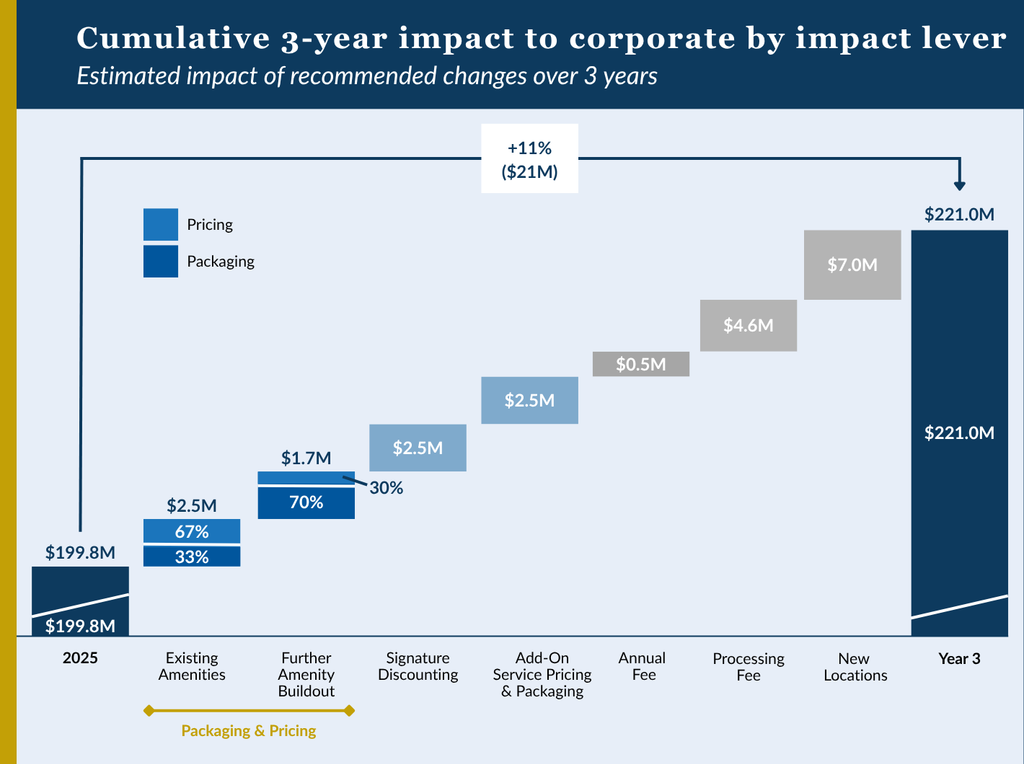
Incremental revenue upside over three years:
- 11% CAGR improvement
- $20M in corporate royalty revenue
Before: tier structures were complex and inconsistent across company-owned and franchised locations, and corporate had limited visibility into local pricing.
After: the company has a single, more consistent pricing architecture with room for justifiable local adaptation based on competitive intensity and willingness to pay, plus a tool that supports centralized management of pricing.
Operational impact: the architecture and tool were endorsed by the company’s CEO and direct reports and enthusiastically received by the franchisee network. That alignment matters in a system where operators, not corporate, set many day-to-day prices.
How results were measured: the upside estimates are built on competitive benchmarks, price elasticity modeling and conjoint-based willingness to pay, and are framed as a three-year incremental revenue opportunity. Prioritized A/B testing is designed to validate the impact in market as recommendations are rolled out, so leadership can track realized results against the modeled opportunity.
How does the company sustain its pricing gains over time?
New processes: pricing is now managed through a consistent architecture and a customized tool, with guardrails that give franchisees clear boundaries for local decisions. A/B testing is built in as the standard step before changes roll out network-wide.
Monitoring: centralized visibility into pricing allows corporate to see where each location diverges from the architecture and where discounting is creeping back.
Future opportunities: the work surfaced additional ideas, including household discounts and loyalty offerings. Leadership has also discussed a quarterly consumer research cadence – combining focus groups, a pulse survey and digital performance tracking – to keep member voice in pricing and promotional decisions.
Where could pricing complexity be costing your network?
Companies with multi-site, membership or franchise models often leave revenue on the table in the same places: tier structures that confuse buyers, discounting that escapes control, and add-on services priced by habit rather than evidence.
This engagement shows what a disciplined pricing strategy can do. A rigorous diagnostic, direct member input and a practical tool for local adaptation turned pricing complexity into millions of identified revenue upside over three years.
If you suspect your own pricing architecture is holding back premium mix, conversion or sales effectiveness, we would welcome a conversation. Contact Blue Ridge Partners to discuss your pricing opportunity.