Industrial MRO Go-to-Market Model Redesign Case Study
Adding 800 Basis Points of Incremental Revenue Growth

Executive Summary
An industrial automation and MRO supplier with more than $1B in revenue had outgrown the sales model that built it. Customers were not differentiated by growth potential, selling was largely transactional, and compensation rewarded activity rather than expansion. Blue Ridge Partners applied its 3-3-3 Revenue Accelerator: a three-day diagnostic, a three-week growth model design and a three-month launch. The work realigned segmentation, sales coverage and incentives around the highest-value accounts. The result was +800 bps of incremental revenue growth and a go-to-market model built to scale, achieved by reallocating existing commercial resources rather than adding sales capacity.
Client Background
How did rapid growth strain an industrial supplier’s sales model?
The client is an industrial automation and maintenance, repair and operations (MRO) supplier with more than $1B in revenue. It serves a broad base of manufacturers and industrial end-users and offers a wide breadth of products. Backed by private equity, the company had historically grown by serving every market segment equally, and having inventory available when customers needed it most accelerated that growth.
Ownership and management were focused on scaling the business against a defined growth target, which the company had recently fallen short of delivering. The commercial organization, built for a smaller company, still applied a largely uniform sales approach to a diverse customer base. Leadership wanted to know whether the go-to-market model that fueled the company’s rise could carry it through its next stage of growth.
The Challenge
Why did the go-to-market model stop scaling with the business?
As the company expanded, cracks began to appear in its commercial model.
Customers were not differentiated by growth potential, so high-value accounts received the same commercial treatment as lower-value, transactional opportunities. Sales motions were largely transactional, and sellers spent time on activities that could be handled more efficiently, which limited their capacity for larger opportunities. Compensation rewarded activity rather than expansion, so the incentive structure did not consistently reinforce the behaviors needed to grow priority accounts.
The business impact was a growing gap between where the company’s greatest growth opportunities existed and where its commercial resources were deployed. Growth fell short of target even as the cost of commercial inefficiency compounded. High-potential accounts were under-served, seller time was consumed by low-value activity, and the sales organization had no clear, company-directed plan for where to focus.
The central question was not how to add sales capacity. It was how to reallocate commercial resources toward the accounts and activities with the greatest potential to accelerate growth.
The Diagnostics
What did the 3-day diagnostic reveal about growth barriers?
The first phase of the 3-3-3 Revenue Accelerator, Find the Money in 3 Days, was a rapid but comprehensive review of the entire go-to-market model. The team combined customer interviews, internal discussions, market and sales effectiveness analyses, and an on-site visit to examine:
- Buyer values, service preferences and customer satisfaction
- Customer and account segmentation
- Sales coverage, seller activities and sales process by segment
- Commercial roles, skills and the behaviors required to drive profitable growth
- Sales compensation and incentives
Four findings stood out:
- The market was not sufficiently segmented, with no clear line between high-potential accounts and transactional customers
- The commercial model lacked a company-directed approach to growth
- Sales motions were transactional and not aligned to opportunity value
- Compensation did not reward expansion of priority accounts
Each finding pointed to the same underlying pattern: the model that built the business was not the model needed to scale it. High-value opportunities were competing for seller attention with lower-value transactional activity, and the incentive plan did little to change that.
The critical insight was that the company had a commercial allocation problem, not an activity problem. Sales resources were not aligned to account potential, and the path to the next phase of growth was better allocation of sales capacity rather than more sales activity.
The Solution
What did the 3-3-3 Revenue Accelerator recommend and why?
In Phase 2, Design the Growth Model in 3 Weeks, Blue Ridge Partners and the sales organization developed three interconnected growth sprints. Together they changed who the company focused on, how it sold and what it rewarded.
- Sprint 1: Put the right accounts in focus.
- Objective: shift from broad coverage to deliberate account prioritization.
- Action: segment the customer base across key industry sectors and build account priorities, named-account assignments, account plans and growth objectives for priority accounts.
- Expected impact: sellers gain a clear view of where to invest disproportionate effort.
- Sprint 2: Match sales coverage to customer value.
- Objective: put high-cost, high-touch resources where they create the most value.
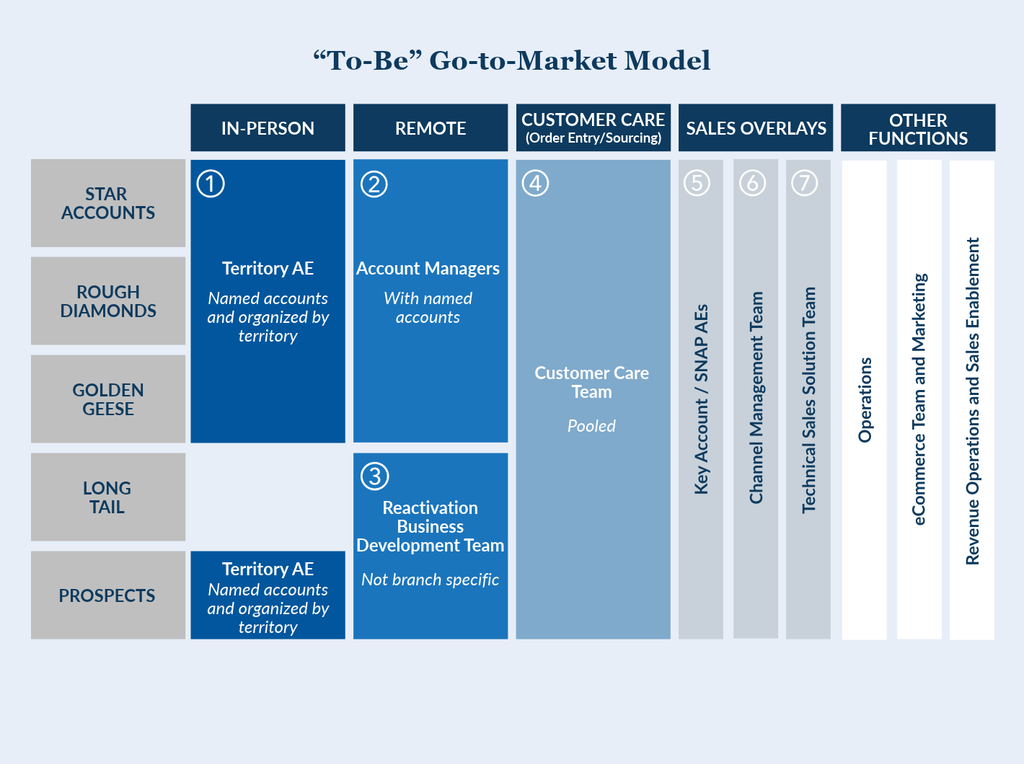
- Action: rebalance inside and outside sales responsibilities, align outside sellers to named accounts and pool transactional activity in a dedicated team.
- Expected impact: higher-value sellers are freed to pursue strategic growth opportunities.
- Sprint 3: Pay for growth.
- Objective: connect what leadership wants to what sellers are rewarded for.
- Action: redesign compensation to tie incentives to growth in priority accounts and outperformance against targets.
- Expected impact: growth becomes economically meaningful to the sales force.
The recommendation was tailored to a company that had grown by serving everyone. Rather than adding headcount, it redeployed the resources already in place. The sprints were sequenced so that account priorities came first, coverage design followed from them, and incentives reinforced both. A high-level sequencing plan prioritized the changes by value and risk, so leadership could begin with the moves that were easiest to land and build momentum for the larger structural shifts.
The Execution
How was the new model launched in the field in 3 months?
A new go-to-market model only creates value if the field understands it, believes in it and knows how to execute it. Phase 3, Launch the New Model in 3 Months, focused on making the model usable rather than simply documenting a strategy.
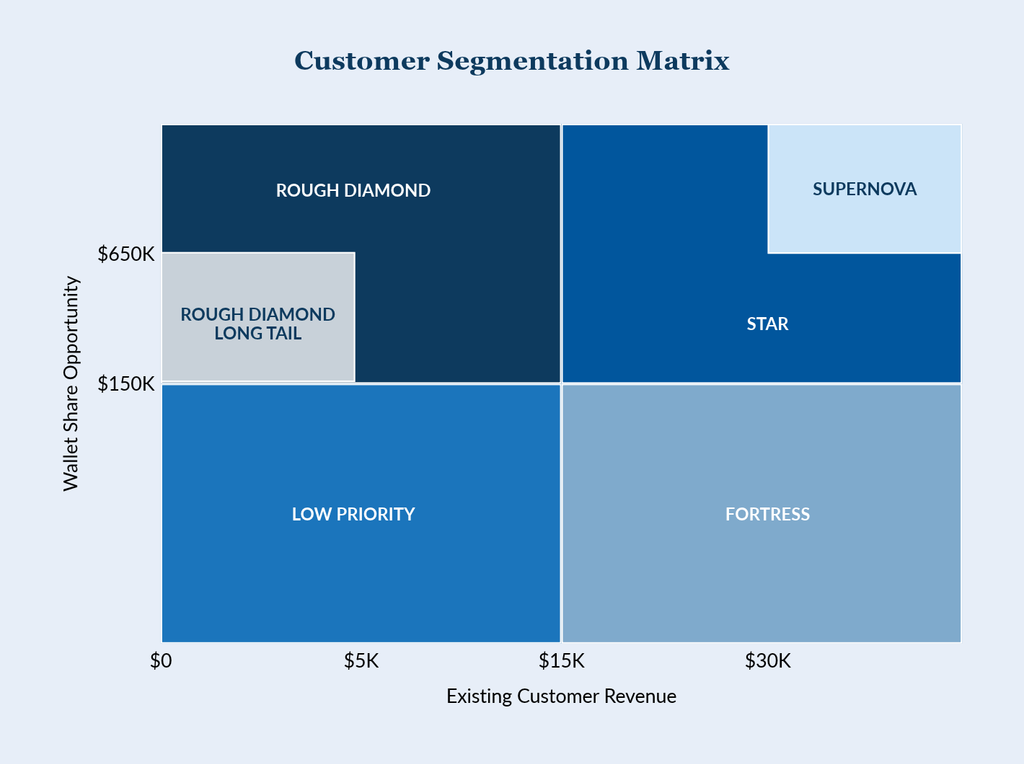
Implementation approach: the team enriched and cleansed internal account data with external firmographic information, then segmented and targeted the customer base to calculate upside potential by account. The segmentation identified 7 key industries and roughly 750 key accounts, about 3% of end-users but approximately 38% of revenue, plus roughly 2,500 additional accounts with significant upside. A capacity model, built from a time study, sized the outside and inside teams and informed new territory lines and named-account books.
Key milestones:
- A communications plan explaining the rationale for the changes and setting expectations across the organization
- A sales kickoff that connected the new model to the growth strategy
- New territory maps, named-account assignments, account books and compensation packages for inside and outside sellers
- Sales playbooks, enablement tools, account-planning materials and activity trackers, including an interim tracker until a CRM was in place
Execution detail: the team sized outside headcount from rep productivity and capacity, defined go-forward roles and responsibilities, set account visit cadences, and prepared a transition plan for affected sellers. Rollout packages were tailored for inside and outside sellers so that every rep received the same core tools and clear expectations.
Timeline: the rollout was phased, starting with the areas identified as lower risk and ramping into the rest of the business. The segmentation framework was then extended to an additional geography.
The Results
What growth did the redesigned go-to-market model deliver?
The redesigned model produced a meaningful growth inflection: an increase of 800 basis points in revenue growth, measured as the improvement in the company’s revenue growth rate. That improvement came from aligning commercial resources, sales motions and incentives around the highest-value opportunities.
Before: growth had fallen short of target, every segment received similar coverage, and compensation rewarded activity.
After: priority accounts had named owners and documented plans, transactional demand was handled by a pooled team, and incentives rewarded growth in the accounts that mattered most.
The new compensation program increased target pay for sellers who deliver growth while remaining cost-neutral to the prior plan.
The impact came from several changes working together: better segmentation, better account focus, better allocation of sales capacity, stronger growth incentives and more effective execution. Rather than trying to sell more to everyone, the organization became deliberate about where to play, how to sell and where to deploy its best commercial resources.
How did the company equip itself to sustain faster growth?
The engagement delivered more than a one-time lift. The company emerged with a repeatable commercial architecture:
- Segmented customer and account priorities, with named-account strategies and account plans
- A differentiated inside and outside sales model with a dedicated approach to transactional activity
- Growth-oriented sales compensation
- New territory and coverage models supported by sales playbooks and enablement tools
- Activity and performance tracking to monitor adoption and results
Looking ahead, the same segmentation and account-planning tools give leadership a way to keep refining coverage, extend the model to new geographies and size the next wave of opportunity within the existing customer base.
Is your go-to-market model built for your next stage of growth?
What gets a company to its first phase of growth is not always what gets it to the next one. If growth has slowed after a period of rapid expansion, the problem may not be demand. It may be that your go-to-market model has reached its limits.
As businesses scale, customer bases become more diverse and the cost of commercial inefficiency compounds. Sellers spend too much time on low-value activity, high-potential accounts receive too little attention and compensation reinforces yesterday’s priorities.
The 3-3-3 Revenue Accelerator helps identify where commercial resources are misaligned, determine which changes unlock the greatest value and rapidly build a go-to-market model designed for the next stage of growth. Find the Money. Design the Growth Model. Launch the New Engine.
Schedule a 3-3-3 Revenue Accelerator diagnostic with Blue Ridge Partners.