Managed Services Go-to-Market Case Study
From Decline to a 13% CAGR

Executive Summary
A private equity-backed UCaaS and managed services provider with roughly $700M in revenue was shrinking about 3% a year, even as it launched new managed services offerings. Blue Ridge Partners redesigned the managed services go-to-market strategy end to end: cross-functional sales pods, data-based segmentation and playbooks, role-fit assessment, simplified compensation and a rebuilt channel partner program. Within two years, revenue grew at a 13% CAGR, compensation cost of sales as a share of revenue fell at a 10% CAGR, and channel manager productivity doubled. The result is a repeatable commercial model that private equity sponsors and management teams can apply to similar growth challenges.
Client Background
What was the growth goal?
The client was a UCaaS and managed services provider (MSP) with approximately $700M in revenue, built on a legacy telecom access business. After a private equity acquisition, the new owner wanted to restructure the organization and move to a business model centered on managed services such as cybersecurity and unified communications.
The company sold through a direct sales force of new-business reps and account managers and through thousands of channel partners, supported by a network of more than 10,000 sub-partners. Leadership had built the new managed services offerings but had not gained growth traction with this critical strategic initiative.
The goal: redesign the go-to-market model and overall commercial effectiveness to accelerate organic revenue growth.
The Challenge
Why was the managed services go-to-market strategy stalling?
Revenue was declining. Customer churn outpaced customer growth, and new logos were not replacing lost customers, resulting in a net revenue decline of about 3% each year.
The commercial model had not kept pace with the business strategy. Reps, account managers and channel partners were selling against each other. Roles were nominally divided between hunters and farmers, yet every rep could sell to any customer in any territory. Strategic products were sold as undifferentiated commodities, with heavy discounting. Revenue was also falling quickly across thousands of channel partners that had never been transitioned to the new product strategy.
The business impact was a growth strategy that existed on paper but not in the field. Margin was eroding through discounting, and the company was funding a sales organization that was working at cross purposes.
The central question: how could the company align its people, roles, incentives and partners behind the managed services strategy?
The Diagnosis
What did the commercial diagnostic reveal?
Blue Ridge Partners built a fact base across the full commercial system: sales structure and channel overlap, market segmentation, digital maturity, forecasting and metrics, sales talent, compensation, and the channel partner network. The work included more than 20 external interviews with partners and a detailed analysis of the sub-agent network.
Five findings stood out:
- Channel conflict was structural. Multiple channels sold to the same customers under separate management, with no clear rules of engagement.
- Reps sold on price, not value. Differentiated messaging was missing for products that deserved it.
- Buyers had changed. Managed services buyers had different priorities than legacy buyers, but few reps had adjusted their targeting or selling approach.
- Talent was misplaced. Psychographic testing showed that nearly 40% of reps and managers were not in roles suited to their personality and psychology.
- Channel focus was missing. The company lacked focus on the key sub-partners driving the business, within the “Top” and the “Curve” of the partner base.
A digital maturity assessment also identified gaps in online presence and brand that limited the company’s reach with new buyers.
The critical insight: the strategy and products were sound. The sales organization, incentives and partner program were still configured for the legacy business, and no single fix would work without addressing them together.
The Solution
What did Blue Ridge Partners recommend to restore growth?
Blue Ridge Partners recommended six connected initiatives, each tied to a root cause from the diagnostic. Rather than a list of isolated fixes, the recommendations were designed to reinforce one another and were sequenced to fit the realities of a sales organization in the middle of a business model transition.
- Cross-functional sales pods. To end channel conflict, hunters, farmers, solution architects and channel managers were organized into regional pods under a single manager, with clear penetration targets and proactive marketing support. The expected impact was better coordination, less duplicated effort and a single point of accountability for each customer.
- Segmentation and sales playbooks. Data-based segmentation refocused the company on key industries and larger prospects, while rep and sales manager playbooks showed where and how to sell on value rather than discount. The expected impact was stronger pricing discipline and messaging matched to the new buyers.
- Front-line manager development. Training, a regular operating cadence, better metrics and a revamped forecasting process gave managers the tools to direct, coach and correct. The expected impact was more consistent execution across regions.
- Role-fit placement. Psychographic testing identified mismatches, and affected reps and managers moved into roles that fit them better, with the expected impact of higher productivity from the same team.
- Simplified compensation. New plans aligned incentives to roles and encouraged solution-based selling, so reps could see how their goals connected to company growth. The expected impact was stronger alignment between rep behavior and company goals.
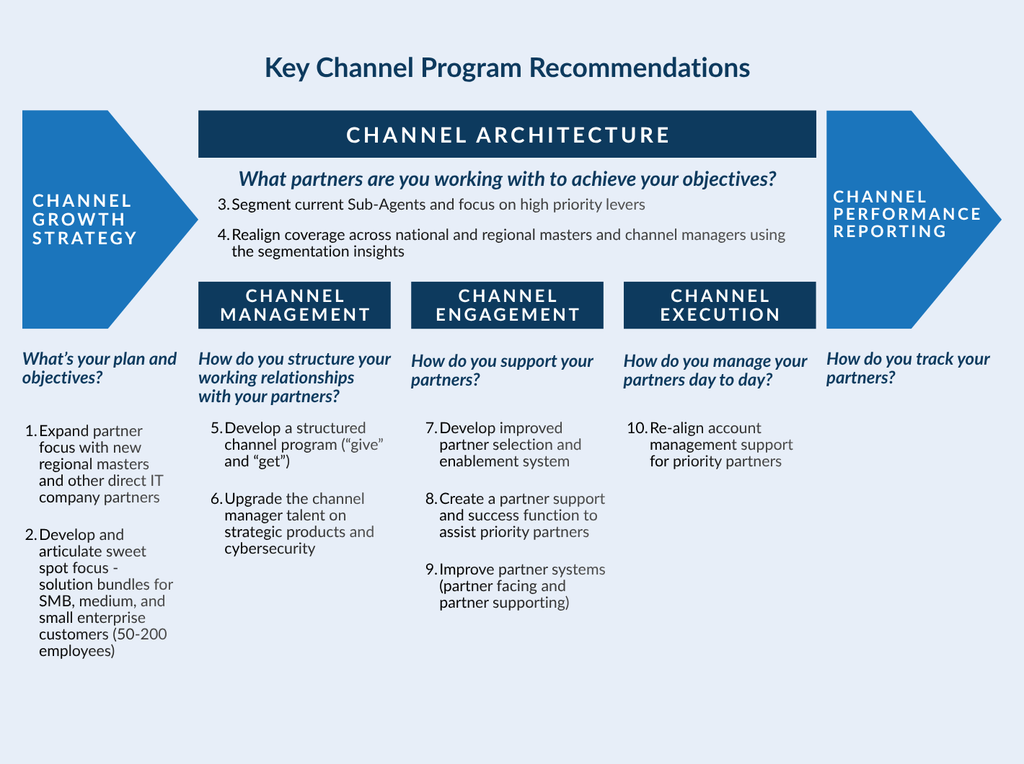
- A new channel partner program. Priority partners were segmented, “get” and “give” expectations were defined, outreach became proactive, and partner enablement improved. Channel managers were realigned to the partners that mattered most. The expected impact was renewed partner enthusiasm and growth across the channel network.
The Execution
How was the new go-to-market model implemented?
Execution ran in three stages, each building on the last. Sequencing the work this way let leadership prove the model in one territory before scaling it.
Stage one: design. The first phase produced the fact base, the new sales structure, market segmentation, forecasting metrics and playbooks. A second phase added a detailed coverage model, a talent assessment and rollout plans for each initiative.
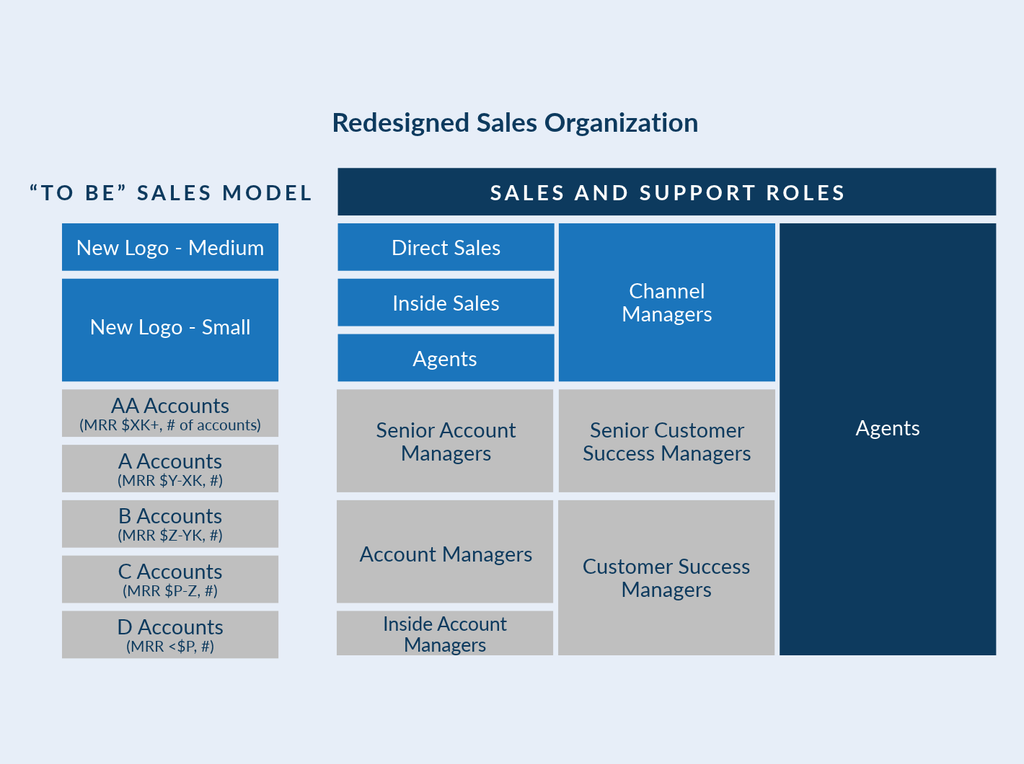
Stage two: pilot. Rather than change the whole organization at once, Blue Ridge Partners led implementation in a single territory. The pilot tested the sales pod structure, in which new-business reps and account managers report to one manager, along with a new lead generation process, rep and manager playbooks, and defined leading and trailing metrics. Territories were built from market opportunity, existing customer locations and rep locations. Staffing needs were estimated for each territory, and those with resource gaps were identified. A new compensation plan was designed to complement the model and was agreed by management. The pilot succeeded, and additional pods were scheduled for rollout.
Stage three: channel transformation. Informed by more than 20 external interviews and analysis of a network of more than 10,000 sub-partners, the new channel partner program was designed and launched with segmented partners, defined expectations and realigned coverage.
Milestones along the way included management agreement on the new compensation designs, a successful pilot in the first territory, and the launch of the redesigned partner program.
Across all three stages, the focus stayed on daily commercial behavior: who calls on whom, how deals are coached and what reps are paid to do.
The Results
What financial results did the new model deliver?
Before the engagement, revenue was declining about 3% a year. Over the two years that followed, revenue grew at a 13% compound annual growth rate, a swing of roughly 16 percentage points. The original financial model had projected a recovery to high single-digit growth at flat costs.
Growth did not come at the expense of efficiency. Compensation cost of sales, measured as a share of revenue, declined at a 10% CAGR over the same two years.
The channel program delivered its own gains. Channel manager productivity and channel growth doubled once priority partners were segmented, enabled and aligned to dedicated coverage.
Operationally, channel conflict fell, morale improved, and productivity rose through better role alignment and process upgrades. Reps could understand what they needed to do to reach their compensation goals.
Results were measured as compound annual growth in revenue against the pre-engagement baseline of decline, alongside compensation cost as a share of revenue and channel manager productivity.
How did the company sustain and extend the gains?
Blue Ridge Partners left the organization with the operating system to keep improving. Sales and sales manager playbooks codified best practices. Front-line managers were trained and equipped with a clear cadence and metrics. Leading and trailing indicators, together with a revamped forecasting process, gave leadership an early read on performance. The channel partner program embedded structured expectations and enablement for partners.
Pod structures carried clearly defined penetration targets, so accountability was visible at the regional level.
Future opportunities remain. Additional pods were slated for rollout, and the digital maturity assessment identified gaps in online presence and brand that offer a roadmap for further growth.
Is your go-to-market model built for your new offerings?
Many companies launch new offerings faster than they reorganize to sell them. The warning signs are familiar: churn that outpaces new logos, reps and partners competing for the same accounts, heavy discounting on differentiated products, and roles that no longer fit the strategy.
Blue Ridge Partners helps private equity-backed companies and their sponsors diagnose where a managed services go-to-market strategy is losing value and build a practical plan to fix it. If your growth initiatives are not gaining traction, let’s discuss what is holding them back. Contact Blue Ridge Partners to schedule a conversation about where your commercial model may be leaving growth on the table.