Commercial AI Value: What Drives Revenue Growth (and What Doesn’t)
Commercial AI investments have surged, yet many companies struggle to translate those tools into sustained revenue growth. While the promise of machine learning and predictive insights captures headlines, the economic impact often falls short in practice.
Based on our work with commercial leaders and private equity-backed companies, the real differentiator is rarely the technology itself. The difference is execution: how AI is embedded into workflows, decision-making, and commercial discipline.
This post outlines what drives real commercial AI value, why many initiatives stall, and what high-performing teams do differently to convert AI investment into measurable revenue impact.
Executive Summary
- Commercial AI value is driven by execution readiness, not tool sophistication.
- Most AI initiatives underdeliver because they sit outside core workflows.
- High-performing teams use AI to reduce low-value work and improve win rates, forecasting, and retention.
- The best companies adopt AI in waves, building foundational capabilities before scaling advanced use cases.
- AI creates leverage only when data quality, planning, implementation discipline, and management routines are in place.
In short, commercial AI creates value only when it is embedded into a disciplined revenue engine.
What Drives Commercial AI Value
AI and advanced analytics can improve performance across sales, marketing, and customer success. Yet many mid-sized companies struggle to realize meaningful ROI.
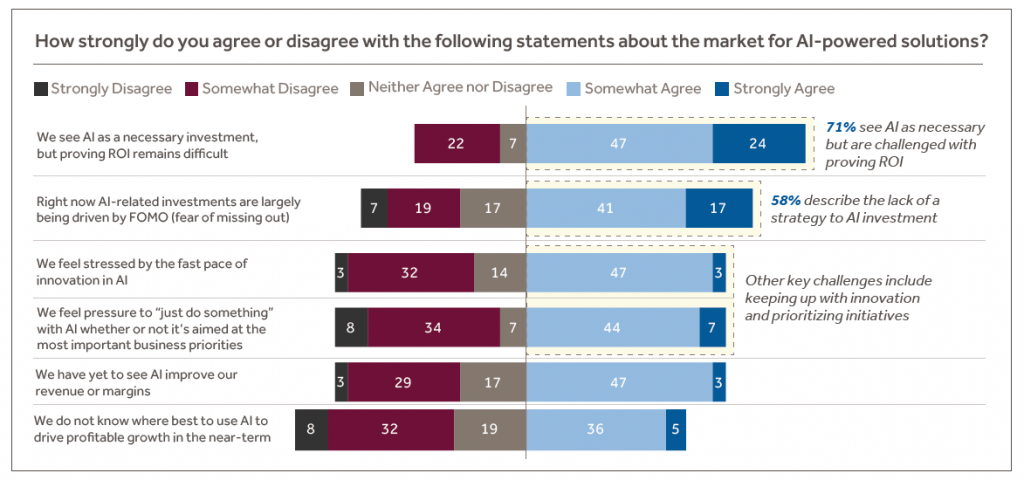
In our research, 71% of commercial leaders view AI as a necessary investment. But most still find it difficult to prove value. More than half admit that AI investment decisions are driven more by fear of missing out than by strategy.
The result is often fragmented adoption: disjointed tools, outdated workflows, and commercial teams overwhelmed by conflicting systems and inconsistent data.
Where Commercial AI Struggles to Deliver Impact
The execution gap shows up clearly in how commercial time is spent.
More than 50% of commercial team members report spending most of their time on non-revenue-generating work, including internal coordination and system management. Even when teams are selling, more than half of selling time is spent on low-value opportunities.
These are not isolated failures. They are patterns that emerge when AI adoption outpaces the organization’s ability to absorb it operationally — a dynamic we describe in the execution gap between insight and execution.
What High Performers Do Differently
Companies in the top 20% of commercial performance show a different trend. They use AI to improve both efficiency and decision quality.
High performers report that AI helps them:
- Reduce time spent on administrative work by 16%
- Boost win rates by 15%
- Increase sales forecast accuracy by 15%
- Improve gross revenue retention by 13%
These results are not driven by simply buying more tools. They come from integrating AI into the commercial operating model.
In short, AI creates value when it is embedded into execution, not when it is layered on top of broken workflows.
Five Actions That Drive Commercial AI ROI
High-performing companies do not treat AI as a standalone initiative. They align it to commercial priorities and redesign how work gets done. Their approach centers on five actions:
- Align AI initiatives to business outcomes rather than vendor-driven feature adoption
- Focus on specific commercial activities where execution bottlenecks exist
- Redesign workflows and reinvest productivity gains rather than leaving time savings unrealized
- Build internal data and operating capabilities that make AI outputs reliable and trusted
- Measure adoption rigorously so AI becomes part of the commercial cadence, not a side project
Three Waves of Commercial AI Adoption
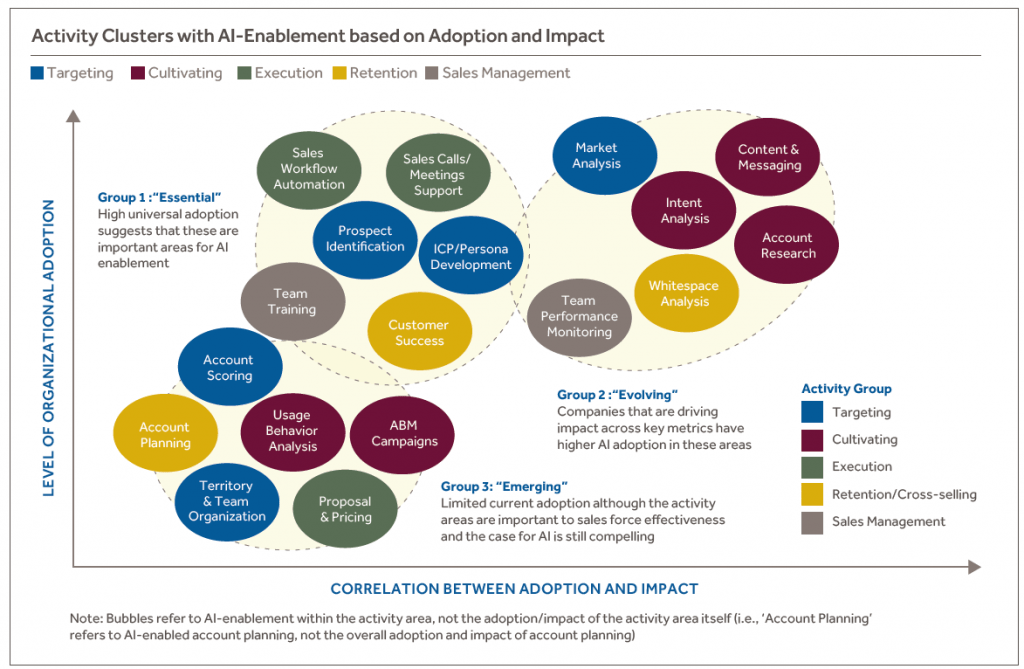
Our research shows that AI adoption typically occurs in three waves:
- Essential AI
These tools are widely adopted and relatively easy to deploy, including sales workflow automation and customer success platforms. They provide incremental gains but rarely transform performance without deeper execution change. - Evolving AI
These tools are less common but strongly linked to performance gains, including intent analysis and whitespace analysis. Companies using them report better targeting, retention improvement, and cost efficiency. - Emerging AI
These applications include advanced account scoring and pricing optimization. They require higher-quality data and stronger workflow integration but represent the next frontier of commercial transformation.
The Four Organizational Enablers of Commercial AI Success
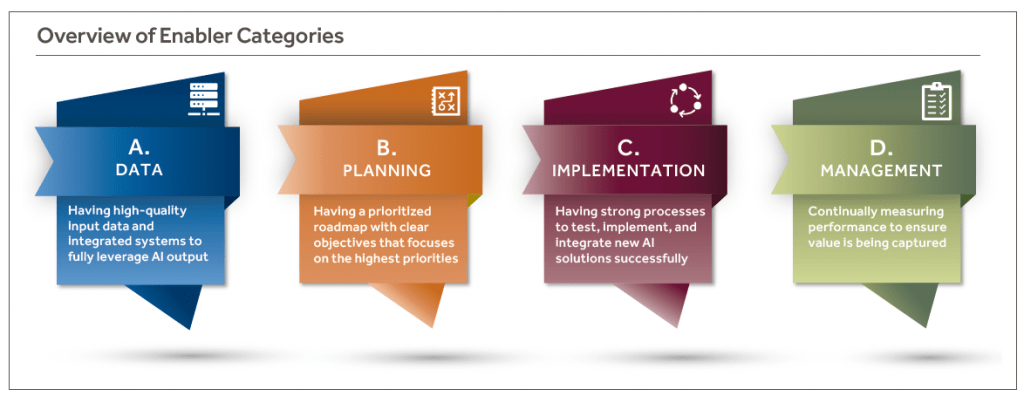
The strongest companies build AI capability on a foundation of four enabling disciplines:
- Data
Clean, validated, and integrated data is essential. High performers invest heavily in both manual and automated data quality improvements. - Planning
Strategic roadmaps, not vendor hype, should guide adoption. Embedding AI into core workflows prevents waste and improves prioritization. - Implementation
High performers pilot AI tools, integrate them into day-to-day execution, and use playbooks to standardize rollout. - Management
AI initiatives require continuous review. Leaders track outcomes, compare AI insights to real results, and benchmark performance across teams.
Without these enablers, AI becomes fragmented experimentation. With them, AI becomes a repeatable commercial advantage.
Frequently Asked Questions About Commercial AI
- What is commercial AI?
Commercial AI refers to the use of AI and advanced analytics to improve sales execution, marketing effectiveness, pricing performance, forecasting accuracy, and customer retention. - Why do commercial AI initiatives fail?
They fail when AI insights sit outside daily workflows, data quality is weak, adoption is inconsistent, and leadership does not build governance and accountability routines. - What commercial AI use cases create the most value?
The highest-value use cases are those that improve execution, including pipeline prioritization, sales enablement, churn prediction, pricing optimization, and forecast accuracy. - How should companies prioritize commercial AI investment?
Start with foundational workflows and data quality, then scale into higher-impact predictive and execution-enabling applications once readiness is established.
Ready to Cut Through the Noise and Focus on High-Impact AI?
Blue Ridge Partners’ Commercial AI Center of Excellence works directly with executive teams to prioritize AI investments and drive measurable revenue impact. If you’re evaluating where to start — or why current investments aren’t paying off — we’d welcome the conversation.