AI Customer Segmentation: Turning the Long Tail into Profitable Revenue Growth
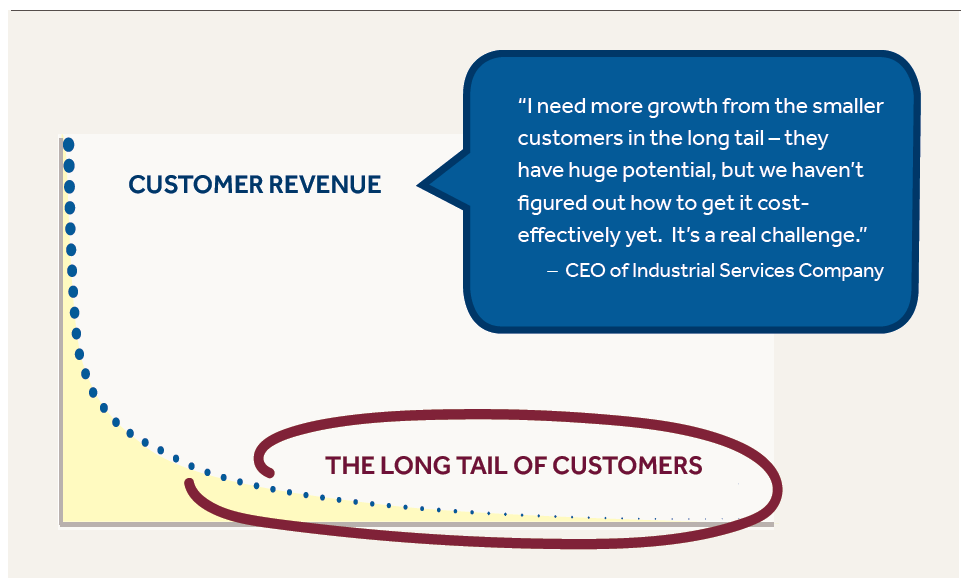
AI customer segmentation has the potential to unlock meaningful revenue from the long tail of smaller customers. Yet many organizations struggle to translate segmentation insights into sustained profitable revenue growth.
Traditional go-to-market models prioritize enterprise accounts and large deals. Smaller customers are often treated uniformly, managed reactively, or supported through low-touch channels without strategic differentiation. In aggregate, however, these accounts can represent a substantial growth opportunity.
The difference between unrealized potential and scalable revenue is not the sophistication of the model. It is whether AI-driven segmentation is embedded into commercial execution. As we’ve explored in our work on AI for commercial performance, revenue impact depends on integrating AI into disciplined workflows.
For private equity investors, operating partners, and commercial leaders, the long tail represents one of the most overlooked value creation levers – particularly as profitable revenue growth remains the #1 driver of value creation.
Executive Summary
- AI customer segmentation can unlock significant revenue from smaller customer segments.
- The long tail often underperforms due to uniform sales motions and weak execution discipline.
- Cohort clustering identifies actionable micro-segments with expansion, pricing, and retention potential.
- Revenue lift occurs only when segmentation insights are embedded into sales, pricing, and workflow routines.
- Commercial readiness – not tool sophistication – determines AI impact.
In short, AI customer segmentation drives value when it shapes how commercial work actually gets done.
What Is AI Customer Segmentation?
AI customer segmentation uses machine learning and behavioral data to group customers into actionable clusters based on purchasing patterns, product usage, churn risk, pricing sensitivity, and expansion potential.
Unlike traditional segmentation models that rely on firmographics or revenue tiers, AI-driven segmentation identifies behavioral micro-segments that predict commercial opportunity.
When applied to the long tail of smaller customers, this approach allows organizations to move from reactive servicing to proactive growth management.
Why the Long Tail Underperforms
Most commercial systems are optimized for large accounts. As a result:
- A single, uniform sales motion is applied across customer tiers.
- Smaller accounts receive limited prioritization.
- Pricing guardrails do not reflect segment economics.
- AI insights remain siloed in dashboards rather than embedded in workflows.
These breakdowns reflect what we describe in the commercial AI execution gap — when insight exists but operational integration does not.
Without workflow discipline, segmentation becomes analysis rather than action.
How AI Customer Segmentation Unlocks Revenue
AI-driven segmentation reveals patterns that are invisible in traditional models. In long tail portfolios, it often surfaces:
- Micro-segments with high cross-sell or upsell potential.
- Clusters with predictable expansion behavior.
- Early churn risk indicators.
- Price-sensitive versus value-driven buyers.
However, clustering alone does not create lift.
Revenue impact occurs when AI customer segmentation directly informs:
- Targeted sales plays embedded in CRM workflows.
- Segment-specific pricing thresholds and discount controls.
- Tailored marketing campaigns aligned to behavioral triggers.
- Retention interventions triggered by predictive risk signals.
This aligns with the broader Commercial AI Inflection Point: value accelerates when AI becomes part of the operating cadence rather than layered on top of it.
What High-Performing Organizations Do Differently
Organizations that successfully monetize the long tail through AI customer segmentation consistently take five actions.
1. Embed Segmentation into Sales Workflows
Cluster designations appear in CRM records and shape call preparation, prioritization, and account planning.
2. Align Pricing to Segment Economics
Different segments receive differentiated pricing logic and approval thresholds.
3. Redesign Coverage Models
Hybrid coverage models combine automation with targeted human intervention to improve efficiency.
4. Establish Clear Leadership Accountability
Leaders inspect performance at the segment level, not just aggregate revenue.
5. Build Continuous Feedback Loops
Models are retrained based on observed buying behavior and retention patterns.
In short, high performers operationalize segmentation into execution routines.
Case Example: Activating Long Tail Revenue
A B2B technology company with thousands of smaller accounts saw stagnant growth in its lower-tier segments. Using AI customer segmentation, the company identified three distinct behavioral clusters:
- Expansion-ready growth accounts.
- At-risk occasional buyers.
- Transactional price-sensitive purchasers.
By embedding cluster insights into CRM workflows, adjusting pricing controls, and deploying targeted outreach:
- Long tail revenue increased 22% within 90 days.
- Churn declined 18% among high-risk clusters.
- Forecast accuracy improved 14% in smaller segments.
The lift did not result from additional headcount or new tools. It resulted from embedding segmentation insight into execution discipline.
Organizational Enablers Required for Success
AI customer segmentation succeeds only when four foundational elements are present:
- Data Discipline
Clean, integrated behavioral and transactional data. - Commercial Planning Alignment
Segment strategies tied to executable playbooks. - Workflow Integration
AI outputs surfaced at the point of decision within CRM and management routines. - Management Cadence
Consistent leadership inspection of segment-level KPIs.
Absent these enablers, segmentation produces noise. With them, it produces leverage.
Frequently Asked Questions About AI Customer Segmentation
- How does AI customer segmentation drive revenue growth?
By identifying behavior-based micro-segments and embedding those insights into sales, pricing, and retention workflows. - Why do long tail AI initiatives fail?
Because segmentation insights remain in analytics dashboards rather than integrated into daily commercial execution. - Does unlocking long tail revenue require heavy AI investment?
No. It requires operational readiness and workflow discipline more than tool sophistication. - Who benefits most from AI customer segmentation?
Private equity-backed companies, operating partners, and commercial leaders seeking scalable topline growth without disproportionate cost expansion.
Strategic Implications for Private Equity and Commercial Leaders
For private equity investors and operating partners, activating long tail revenue can materially enhance portfolio performance. But it requires more than data science. It requires embedding AI customer segmentation into the revenue engine – linking cluster insights to incentives, pricing governance, sales motion, and leadership routines.
Commercial AI does not create value by itself. It creates leverage when integrated into disciplined commercial systems.
Ready to Unlock Hidden Revenue in Your Long Tail?
Most organizations treat small customers as a cost-to-serve challenge. Few use AI-driven segmentation to systematically unlock profitable growth.
Blue Ridge Partners helps leadership teams identify high-potential micro-segments, prioritize targeted plays, and deploy AI-enabled workflows that drive measurable revenue expansion.
👉 Evaluate Your Commercial AI Readiness
Leadership Support
Our Commercial AI work is led by Blue Ridge Partners’ Commercial AI Center of Excellence and our Chief AI Officer, who partner directly with executive teams to translate AI ambition into measurable commercial impact.