Consumer Companies Are Missing the Highest-Impact AI Opportunities

How to Refocus AI Commercial Investment on the Use Cases That Drive the Strongest Growth and Margin Impacts
Executive Summary
- Consumer companies are uniquely positioned to capture outsized value from commercial AI, as small improvements in conversion and value propositions drive disproportionate financial impact, and established commercial systems and data infrastructure enable faster, more scalable deployment than other functions.
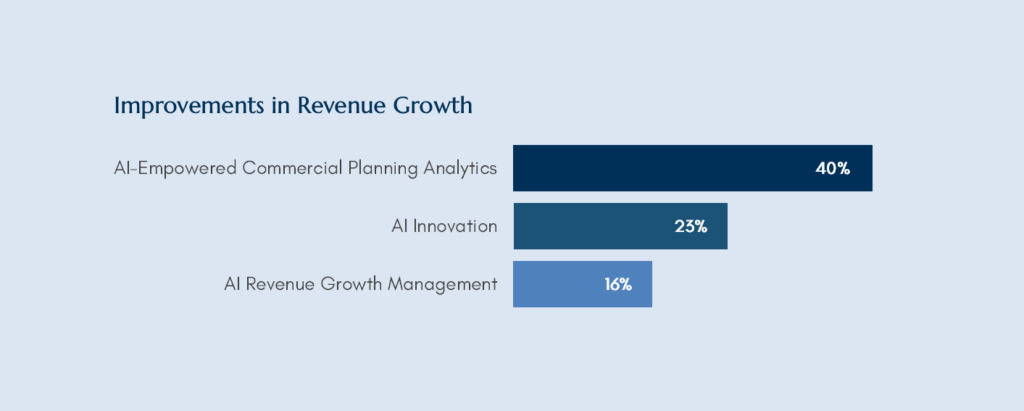
- However, most consumer companies are not investing where the real value is – only 8% are leveraging AI in the most transformative use cases, such as AI-powered commercial planning and analytics, revenue growth from AI innovation, and AI revenue growth management (RGM).
- Companies that focus on these high-impact use cases are generating stronger returns while often investing less in AI, concentrating resources on a smaller number of transformative initiatives.
- Despite this, only 20% of consumer companies are prioritizing at least one of these highest-impact commercial use cases, highlighting a significant gap between where companies invest and where value is created.
Closing this gap requires a disciplined approach: benchmarking investments, integrating workflows, scaling adoption, and prioritizing the highest-impact use cases.
About the Survey
Blue Ridge Partners recently conducted a survey of over 300 consumer industry executives, managers and specialists from both public and PE-owned companies in the US. The study focused on the application of AI to key commercial functions, from the highly strategic areas of revenue generation to more executional areas like media and campaign optimization.
Why Commercial AI Delivers Disproportionate Value in Consumer Organizations
Consumer industry executives are bullish on the potential for commercial AI investments, with expected EBITDA impacts over the next 12-24 months to be 1.3 to 2.1 times higher than AI impacts in non-commercial functions, such as supply chain, product strategy, people and finance. Commercial AI investments can be implemented fast with fewer demands on the organization. Returns can often be measured in weeks or months, whereas AI investment in operations or supply chain can often take a year or two for full impact to be realized.
The consumer industry represents a unique opportunity to drive profitable revenue growth with commercial AI. A single-digit improvement in consumer conversion or net price realization can dwarf the impacts of logistic improvements or cost takeout efforts. Most consumer companies have well-designed sales, marketing, and innovation functions with more standardized end-to-end processes than they do for manufacturing or logistics processes. They often have already invested in integrated CRM systems and data warehouses with a high degree of data cleansing. And consumer companies can deploy commercial AI technologies faster since many AI tools are either already embedded in their commercial tech stack or are easily bolted on.
The Disconnect Between Where Companies Invest and Where Value is Created
Consumer companies broadly agree on three core areas for commercial AI investment: sales and customer management, marketing and consumer engagement, and consumer insights. However, alignment breaks down at the use case level, where the gap between where companies invest and where value is created becomes most pronounced.
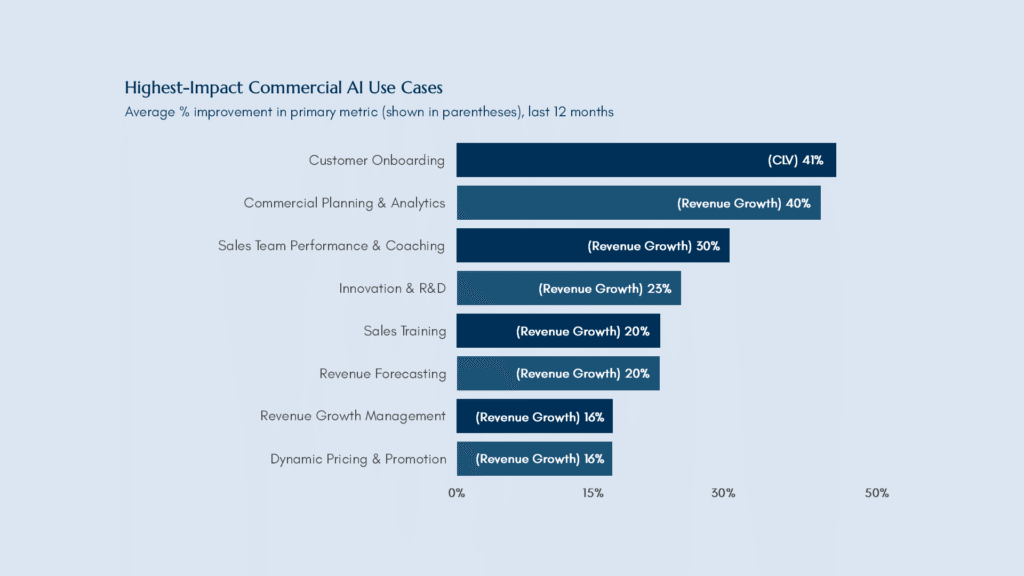
For example, companies report 16-40% improvements in revenue growth from AI-enabled commercial planning, innovation, and revenue growth management, yet fewer than 8% are investing in these areas. Importantly, companies focusing on these high-impact use cases are not spending more – in fact, they are often investing less overall while generating higher returns. Meanwhile, more commonly adopted use cases, such as content development and ad optimization, deliver materially lower returns.
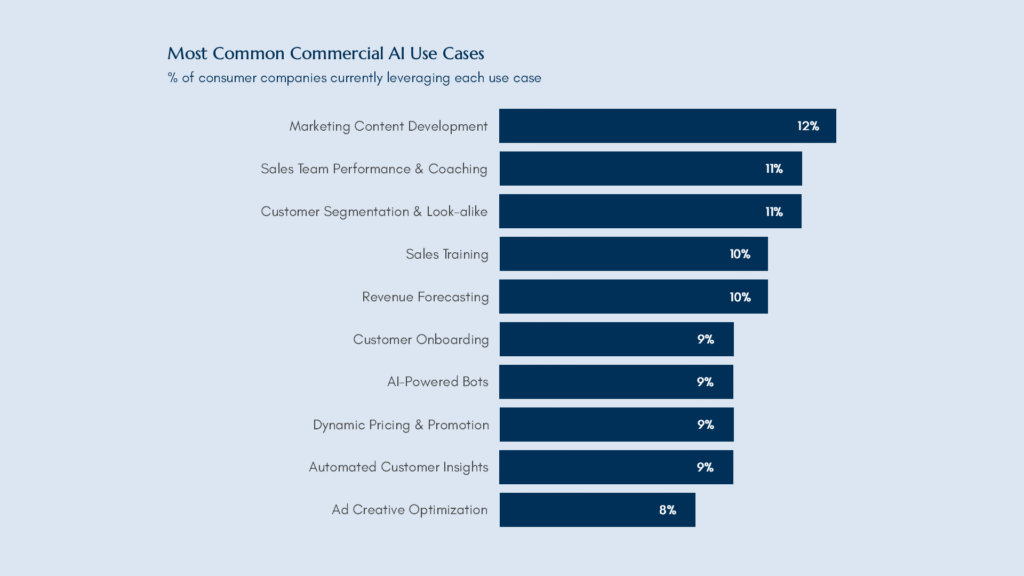
While several commercial AI use cases are delivering meaningful impact, adoption is not aligned with value. The chart below highlights the highest-impact commercial AI use cases by average performance improvement, with underinvested use cases called out.
Why are consumer companies focusing most of their AI investment on “surface-level” use cases and not investing more frequently in deeper impact areas? There are a number of potential explanations, many of which were surfaced directly in interviews during the survey process:
- Time to value seems to beat total value. Use cases that can deliver impacts in weeks or months seem to win out over AI use cases that require much longer (6-24 month) impact windows.
- Tendency to select use cases based on slick demos, rather than robust business cases. Several executives noted that, in the absence of strong data, teams can be swayed by polished vendor materials and early demonstrations.
- Use cases that impact only one function are easier to implement. RGM, commercial planning, and R&D investments require more cross-functional integration and cooperation and more end-to-end process redesign.
- AI use cases that have cleaner, more accessible data are also easier to implement. The more frequently implemented commercial use cases often rely on a single data source. For sales coaching, CRM data should be sufficient, for segmentation and lookalike modeling, marketing data should be mostly sufficient, and for forecasting use cases historical sales data is typically enough to begin the AI training. The higher-impact use cases would potentially require data from retailers, distributors, as well as internal data or require more complex datasets integrating pricing, promotions, consumer elasticity data, and consumer insights.
- There is lower perceived risk in many of the more frequently mentioned AI use cases, whereas the downside of making poor decisions in retail strategy, pricing, or innovation could have lasting negative impacts on the business for years to come.
- A degree of “AI theater” versus true AI transformation. Some companies acknowledge piloting AI in areas where impacts are easy to demonstrate and easier to explain to boards and management, rather than prioritizing more complex, higher-value opportunities.
Companies are focusing less on maximum impact and more on speed, risk reduction, and avoiding organizational friction while they concentrate on a conservative approach of crawling and walking forward with their AI investments.
Interestingly, those companies that are investing in at least one of the top impact use cases are spending less incremental investment in AI (beyond what is already embedded in their commercial technologies) compared to those companies that are investing in lower-impact use cases.
Those companies that are invested in the highest-impact use cases are spending on average just $15M on their commercial technology and AI investments, versus $20M for those companies that are not investing in any of the top ten impact use cases. They are also spending significantly less on incremental AI investment (beyond what is already embedded in their commercial technologies ($2.5M versus $10M). This means returns on commercial AI investment are significantly higher for the consumer companies that are focusing on fewer, higher-impact AI investment areas.
We dug a little deeper and uncovered some additional interesting insights about those consumer companies that have focused on the highest-impact commercial AI implementations:
- They are more likely to be experimenting with AI agents
- They believe AI will increase their workforce, not decrease their workforce, and they expect workforce adjustment to happen sooner
- They are much more confident in their ability to build strong AI business cases
- They are more likely to buy AI tools versus building them on their own
Closing the Gap: Four Actions to Capture High-Impact AI Value
Consumer companies generating the highest returns from commercial AI are taking a more focused and disciplined approach. The implication is increasingly clear: consumer companies that scale commercial AI in a few, high-impact AI use cases are seeing measurable gains in growth and efficiency, while those that experiment and invest in many, lower-impact use cases are not seeing the same level of returns.
The choice of Commercial AI use case matters. The companies that are getting high-impact returns from their AI investments take the following four actions:
- Benchmark their commercial AI spending and impacts. Transformational AI investments are more complex to implement but deliver higher returns. CEOs and their management teams should push their functional teams to benchmark AI use case investments and challenge point solutions with smaller impact business cases.
- Move from point solution pilots to end-to-end process redesign and transformative AI solutions. Fragmented experimentation will not create long term advantage. Consumer companies should map end-to-end commercial processes and reimagine AI applications in light of a more integrated view of workflows. Our study has documented much higher returns from transformative use cases over single point solutions.
- Standardize and accelerate adoption. Develop repeatable AI toolkits, such as audits, benchmarks, prioritized use case libraries, vetted vendors, and standardized workflows, so functions can deploy high-impact solutions quickly and with lower execution risk. For some consumer companies, there may be great benefit in partnering with other consumer companies to share internal best practices, use case impacts, and preferred vendors.
- Prioritize and invest in the AI commercial use cases that will make the biggest difference in value creation. Our recent piece on The Commercial AI Playbook provides a summary of the highest potential AI commercial use cases that are driving material impacts on value creation.
Consumer industry companies that act with urgency will widen the performance gap; those that delay may find themselves competing from a structural disadvantage. Done well, these four actions can help consumer companies accelerate meaningful commercial AI adoption, reducing duplication and wasted spend, and achieving measurable growth, margin expansion, and enterprise value
creation.
Blue Ridge Partners works with consumer companies to identify and prioritize the highest-impact Commercial AI use cases and translate them into measurable value creation. To learn more, reach out for the full Consumer Industry Commercial AI study. We’d also welcome a conversation about how to translate these insights into impact within your organization.