Unlocking 5%-15% of Trapped Growth in the Commercial Organization
How to capture growth through commercial fundamentals, AI and execution – Lessons from interviews with 72 operating partners and our work with 1,300+ portfolio companies over 25 years.
Background
Over the past year, we interviewed 72 operating partners, and we asked what stands between their portfolio companies and stronger organic growth. We completed these interviews in conjunction with AJ Gandhi, founder and CEO of the GTM Leader Society. During one of our interviews, an operating partner at a European industrials investor told us about a business his firm had recently bought.
The company had roughly €800 million in revenue and was still running its sales pipeline in Excel. He didn’t seem bothered by that. “That’s the amazing hunting ground, where I can have a real impact,” he said. “The basics aren’t novel, but they’re new to these businesses, and the impact is correspondingly large.”
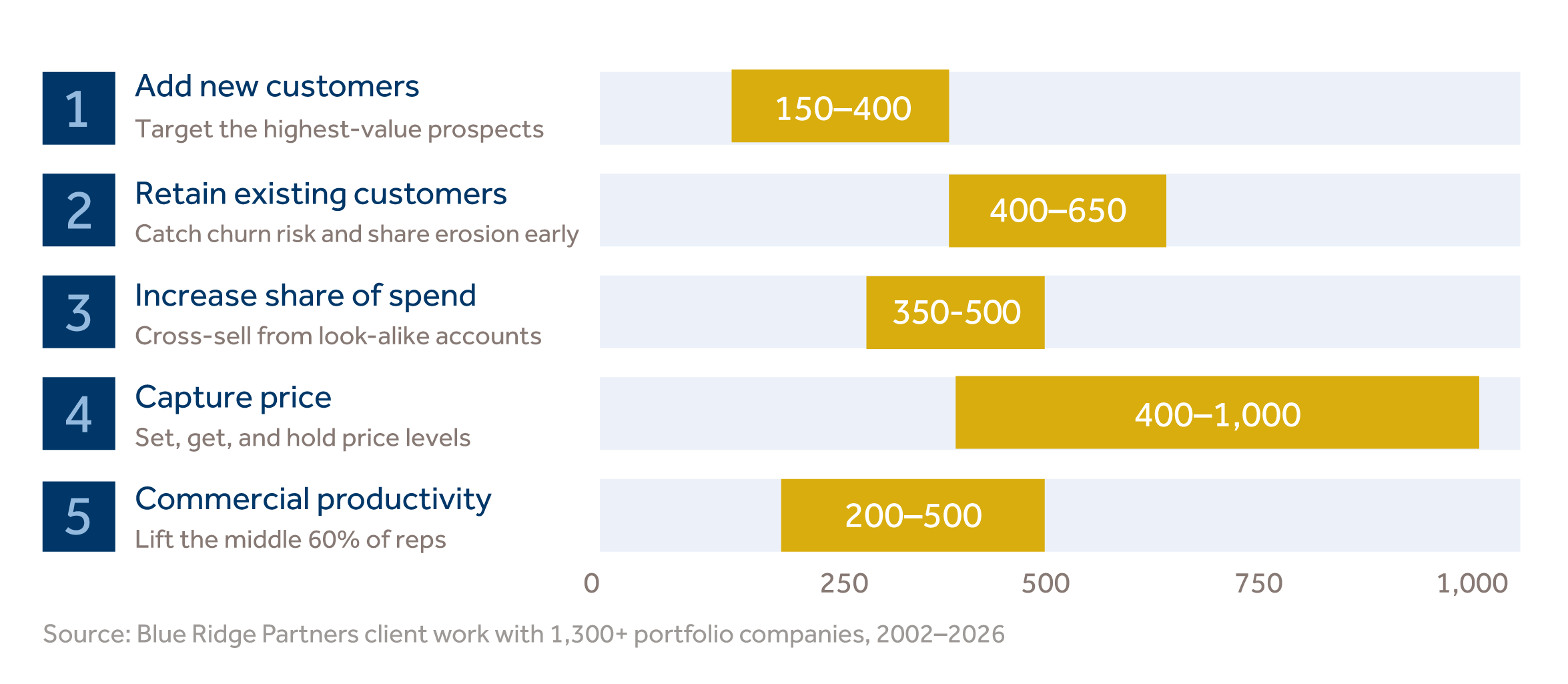
We’ve worked with more than 1,300 portfolio companies over 25 years, and one pattern shows up often enough that we now are not surprised. Most companies have somewhere between 500 and 1,500 basis points of growth inside the commercial organization that nobody is capturing. We call it trapped growth. It’s there but hard to see, and the commercial team usually doesn’t know where it sits. Is it pricing? Cross-sell training? Something else? Most CROs can quote their growth target from memory, but when we ask which lever will deliver it, the conversation tends to slow down.
During our interviews with operating partners, one of the questions we asked was what stands between their portfolio companies
and stronger organic growth. Nine in ten said, one way or another, that the commercial fundamentals aren’t in place. The interviews and our client work point to the same problem: companies have growth opportunities they cannot capture because the commercial fundamentals are not in place.
This is particularly challenging for the 16,000 portfolio companies that have been held for four or more years. More than half are below their target valuation without enough organic growth to close the gap. We believe that 500 to 1,500 basis points of growth can be released within 18 months at many companies (depending on the length of the sales cycle), creating a value creation opportunity for portfolio companies long in the hold.
Why write about this now? Mostly because of AI, which came up in every conversation. Operating partners are using it to find the problem faster as diagnostic work that took three months a few years ago can now be done in days. Others see it as part of the fix itself, and as a way for management to tell whether a change is taking hold.
“If it’s not growing, it’s not selling.”
Senior Operating Partner
Most companies have 500-1,500 basis points of trapped growth
Typical growth unlocked by each core lever, in basis points
1. Why the Growth Stays Trapped
None of this is new; growing a business has always been hard. A revenue engine has a lot of moving parts (ideal customer profiles, demand generation, pipeline conversion, pricing, retention, expansion), and each one affects the others.
Sales, marketing, product, operations, and finance all have a hand in it, but no single function owns revenue. Change is slow, particularly where sales cycles are long. Salespeople have traditionally been left to run their territories more or less as they see fit, and most commercial leaders got their jobs by selling well rather than by designing systems, so they spend their time working in the business instead of on it. And quarter-end pressure always takes priority.
A large-cap software veteran with about thirty years in the industry gave us the best explanation we heard. Go-to-market, he said, “has grown up and evolved rather than being scientifically developed. Finance has accounting standards and a monthly close, and operations has had lean and Six Sigma for decades, but there’s never been anything comparable for sales and marketing.”
Private equity adds its own challenges. When we asked why the fundamentals never got fixed, the answer usually started with how hard change management is. It touches almost every part of the business and depends on people changing how they work – the process they use and their behavior. And this sometimes means replacing the sales leader first before anything else can get started.
Several also mentioned the risk. A real commercial transformation disrupts revenue in the middle of the hold, with a J-curve and a few quarters of poor metrics. Often it tends to happen about the time when the deal team starts thinking about the exit. “It may be the right move for year three in a five-year hold business,” one operating partner told us, “But if the asset is being sold in nine months, it might be the worst move.”
Deal teams are understandably reluctant to underwrite work that pays back slowly and is hard to see in the P&L. As a result, it often gets postponed. That’s how a company can pass through two or three owners and arrive at the next one, still tracking its pipeline with a spreadsheet.
“Go-to-market has grown up and evolved rather than being scientifically developed.”
Operating Partner, Large-Cap Software
2. What the 72 Operating Partners Told Us
The interviews covered 72 operating partners at 65 firms across private equity, growth equity, venture capital, and private credit. These were structured conversations rather than a survey.
We came away with many valuable insights, about half of them related to AI being used in commercial organizations, nearly all of which had documented, implied, or directional value as shared by the operating partners.
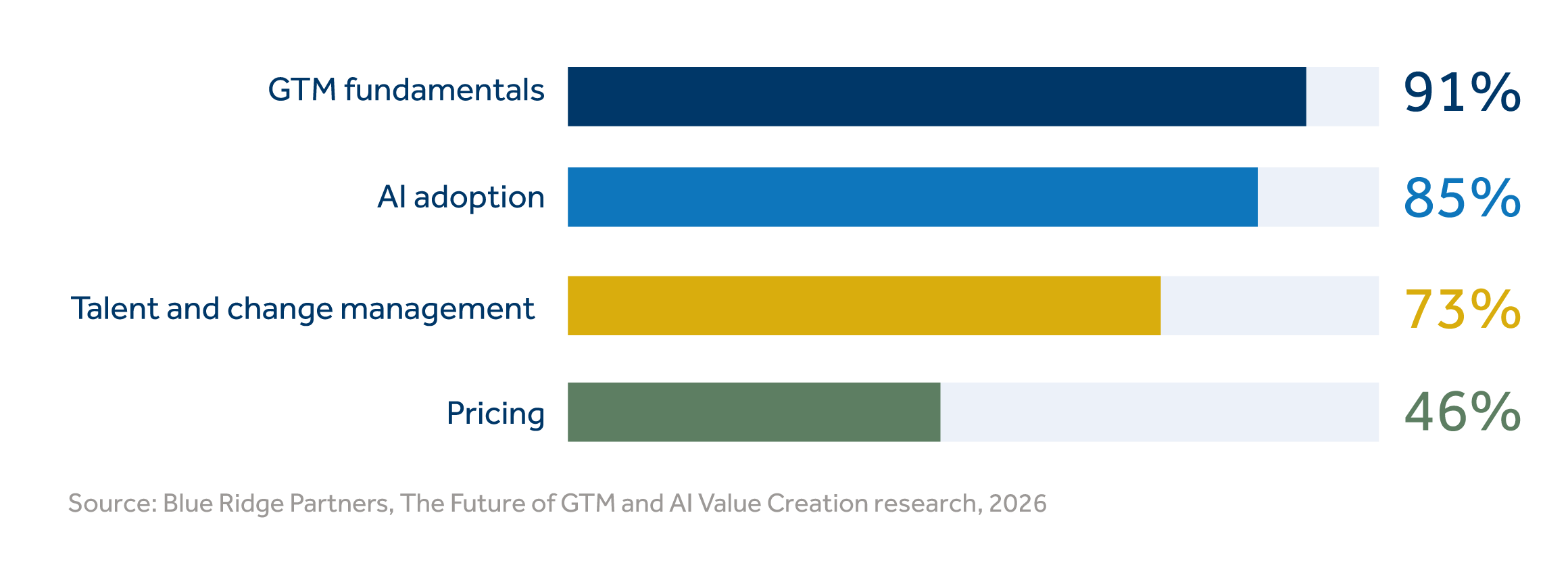
The level of agreement on the challenges to revenue growth was higher than we expected. Ninety-one percent said GTM fundamentals were the main focus of value creation, and most described strengthening the basics as an opportunity at every company they own. AI adoption was close behind at 85%. Most called it early days. Seventy-three percent named talent and change management, and 46% put pricing at the center of their focus.
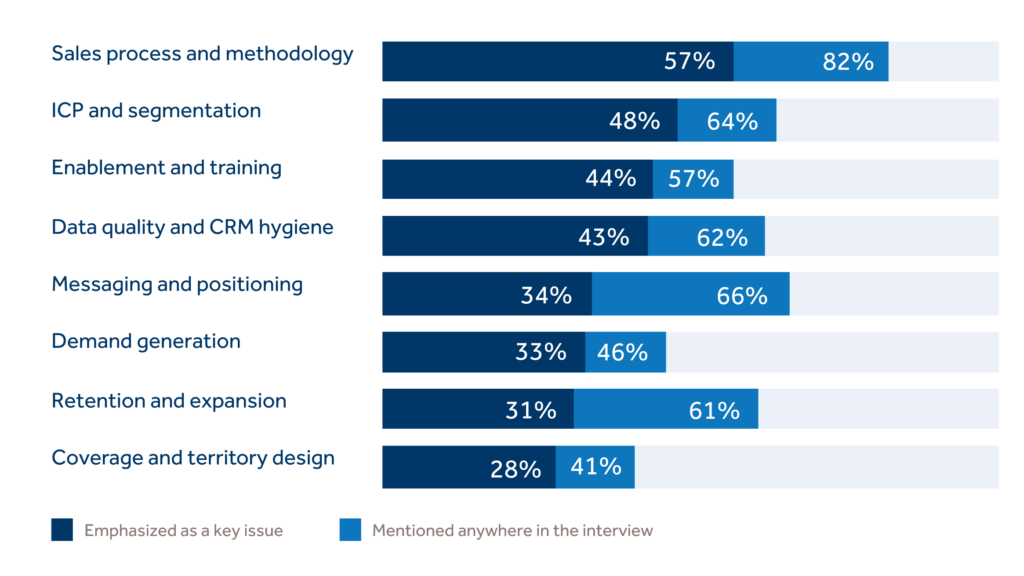
When we looked at what people meant by fundamentals, the gaps ran across the whole commercial engine, and the ones emphasized most were the most basic. Sales process and methodology topped the list and were mentioned by 57% of the interviewees who said they are focused on GTM fundamentals (91% of the interviewees), with ICP and segmentation at 48%, enablement and training at 44%, and data quality and CRM hygiene at 43%. One operating partner described a test their firm ran, “We keep coming back to the same thing: Install the boring weekly sales cadence first. In pilots across four portfolio companies where we did nothing else, sales calls, opportunities, quotes, and win rates all improved fast.”
On AI, most of the people we talked to have moved beyond asking whether it works. “The question has shifted from ‘Where do we use AI?’ to ‘What are we trying to do, and how can AI help?’” one said. “AI is the accelerant, not the destination.” Several told us the harder part is choosing the two or three things that matter at a particular company and then making the changes stick.
“AI is the accelerant, not the destination.”
Operating Partner
What operating partners are focused on
Share of the 72 operating partners citing each as a core focus of value creation
Where the fundamentals fall short
Among operating partners citing GTM fundamentals, the gaps they raised
3. Finding the Money With the Revenue EquationTM
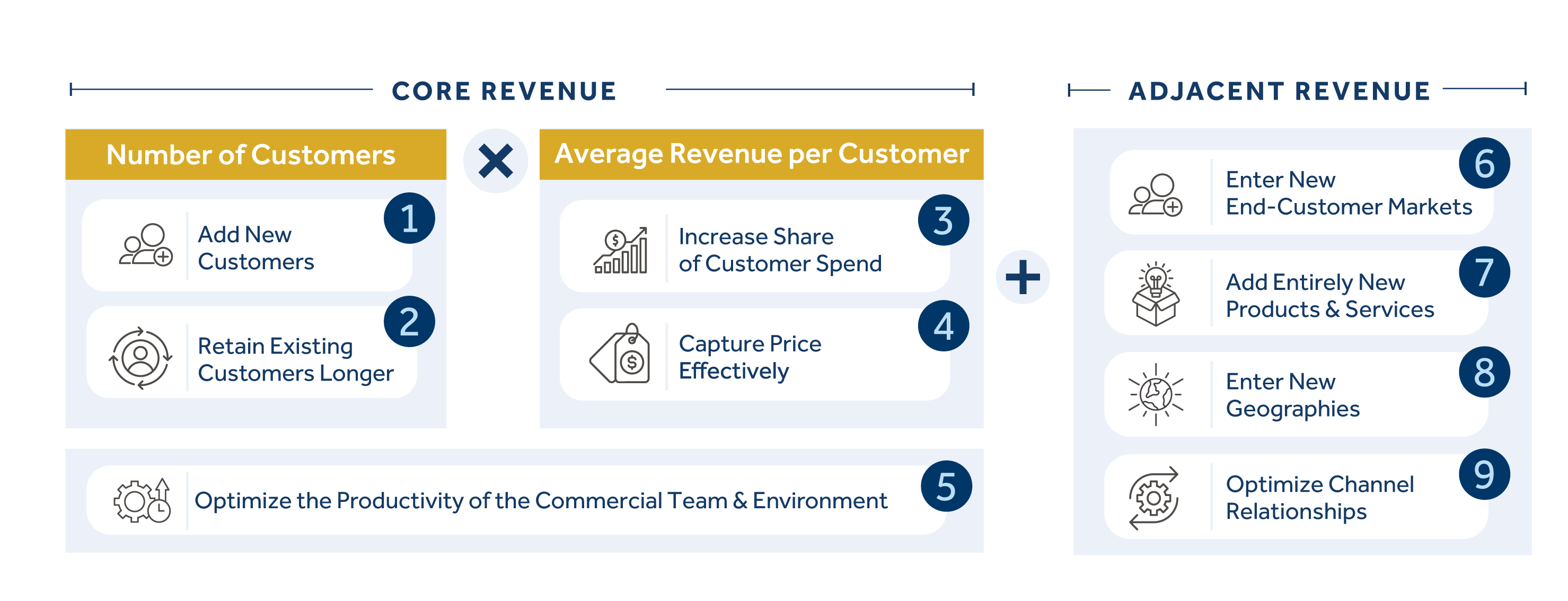
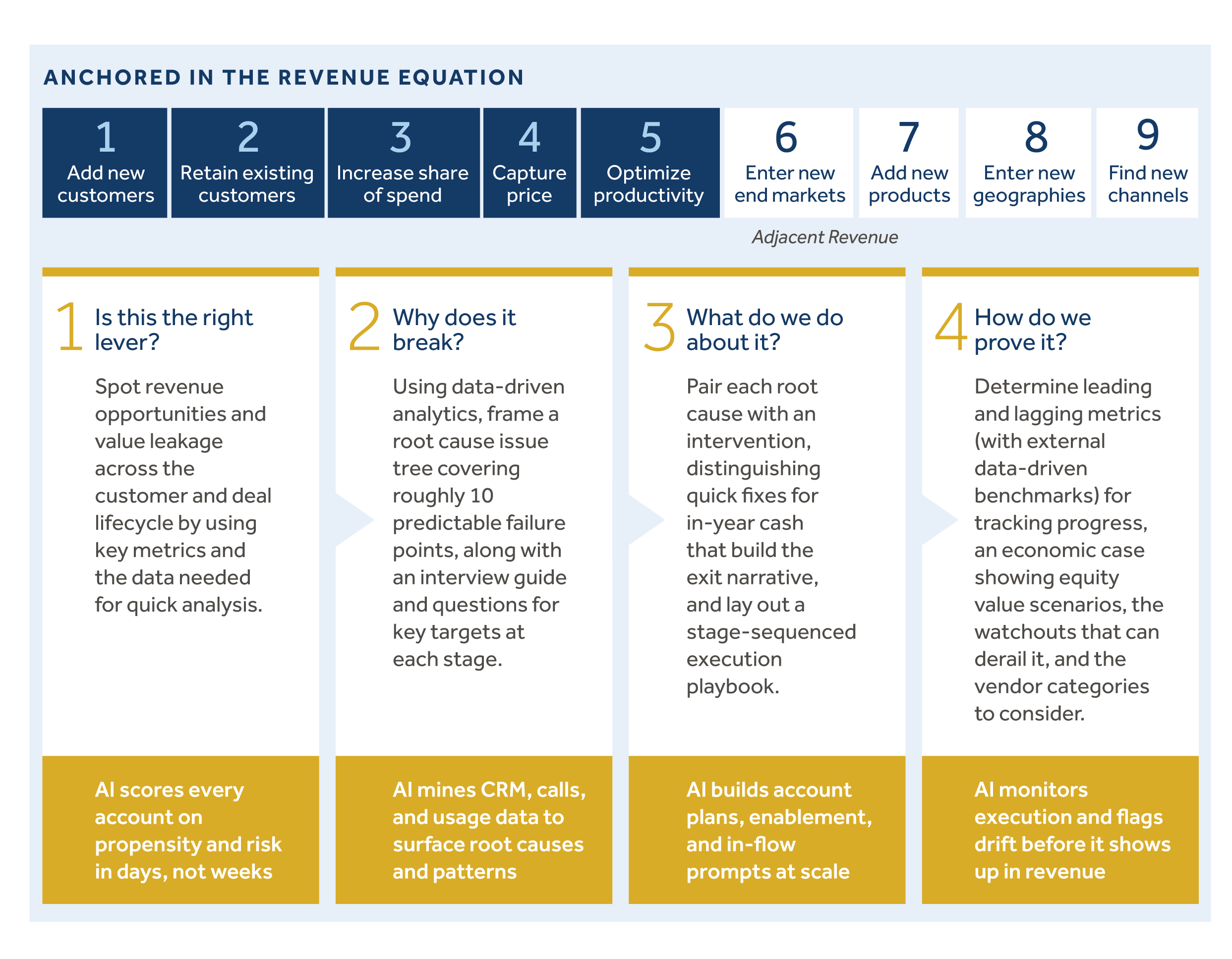
A revenue engine is complicated, but there are only nine ways to improve its performance. Five are inside the existing business: win new customers, keep the ones you have longer, sell them more, price better, and get more out of the commercial team.
The other four involve moving into new end markets, new products, new geographies, or new channels. We call this the Revenue Equation™. Every company has all nine available. The work is figuring out which one or two have the most upside for that particular business.
Finding the money starts with performance metrics for each part of the revenue equation. We compare them against benchmarks, put a revenue and margin estimate on each gap, and rank the results. Done carefully, it leaves a management team with one to two actions that can move the P&L.
Take a software company with about $300 million in revenue. New logos had value, but the market was saturated and acquisition costs had risen 40% in three years, so the feasibility was low for significant near-term economic new logo growth. Renewal was already at 92%, which left little room on retention. Pricing had some leakage, but it needed a project of its own, and a 24-month exit window ruled out new markets and new products.
Share of customer spend looked different. Between 60 and 70% of existing customers bought only a narrow range of the product offering, so cross-sell became the top priority.
This was the first place AI showed up repeatedly in the interviews. Assembling messy commercial data and benchmarking used to take 2-3 months. Now it takes days. Data cleanup, which used to be a prerequisite, increasingly happens alongside the analysis. One operating partner explained it this way: “In data clean-up, AI can accelerate the process. It tells you what’s broken and accelerates the fix. What used to take a year of manual work can now be done in weeks.”
“The question has shifted from ‘Where do we use AI?’ to ‘What are we trying to do and how can AI help?'”
Operating Partner, Global Sponsor
The Revenue EquationTM: nine ways to grow
Every company has all nine; the diagnostic finds the one or two with the most upside
4. Knowing What to Do Is 25% of the Work
Sizing and ranking the opportunities is the easier part. Our rule of thumb is that knowing what to do is about 25% of the challenge and getting it done is the rest. When growth initiatives fail, the analysis is rarely the reason; more often the organization never changed how it works.
Operating partners have watched the same thing happen with AI. “It’s been a full circle,” one said. “Early hype, then lab-quality tools nobody used in production, now comes the realization that the hard part is change management and process redesign.”
For that remaining 75%, we try not to start from scratch each time. For each pathway in the Revenue Equation we maintain a Revenue Design Guide™, a written methodology with benchmarks built in. The guide covers the process and organizational changes alongside the AI use cases that fit. It also lays out the metrics that show whether it’s working, and common mistakes that derail these programs. We built them from our client engagements and update them as we go, so when we work with the next portfolio company we are not starting from a blank page.
AI also plays a second, more operational role. Among the 120-plus use cases we collected, the ones with hard P&L evidence moved the critical commercial KPIs. At one company, win rates went from 19 to 34% after AI was used to sharpen the ideal customer profile, and at another, churn on a $1 billion book fell from 25 to 15%. One firm cut RFP response time from seven days to less than one and picked up ten points of win rate.
Some of the other examples were smaller but equally telling. Call intelligence produced a thousand basis points of conversion improvement at one company, and another recovered $2.5 million of unbilled revenue in a single week. In each of these, AI was part of the daily workflow, providing next actions for sellers along with coaching at a scale that managers typically could not handle alone. The operating partners estimated that this cut the time it took to put the fundamentals in place by 25 to 50%.
The operating partners were careful about how they count results. Time saved only matters to them if it shows up in results such as win rate or retention. As one warned, “A 10% time savings across a thousand people does not equal a 10% performance improvement.”
“It’s been a full circle. Early hype, then lab-quality tools nobody used in production, now the realization that the hard part is change management and process redesign.”
Operating Partner
Revenue Design Guide™
Built from 60-100 projects, each design guide is a proven recipe for one revenue lever, answering four questions (and the role of AI in each) with the benchmarks, root causes, analytics, and process changes specific to your company type and customer, so there’s no need to build it bespoke or from scratch.
Where AI is Already Paying Off
Selected use cases with documented results, by core lever (from 120+ collected)*

5. Implementing the Sprints
In our experience, sprints work better than traditional transformation approaches. The highest priority value creation lever gets finished first, before the next one starts. Running four projects at once spreads the effort too thin and wears out the management team, and many operating partners have learned the hard way.
“I now spend all my time with my portfolio companies trying to do one or two things really well versus three, four, or five at a time,” one senior operating partner told us. “It just doesn’t work otherwise; management teams hate it, and you create unnecessary friction.”
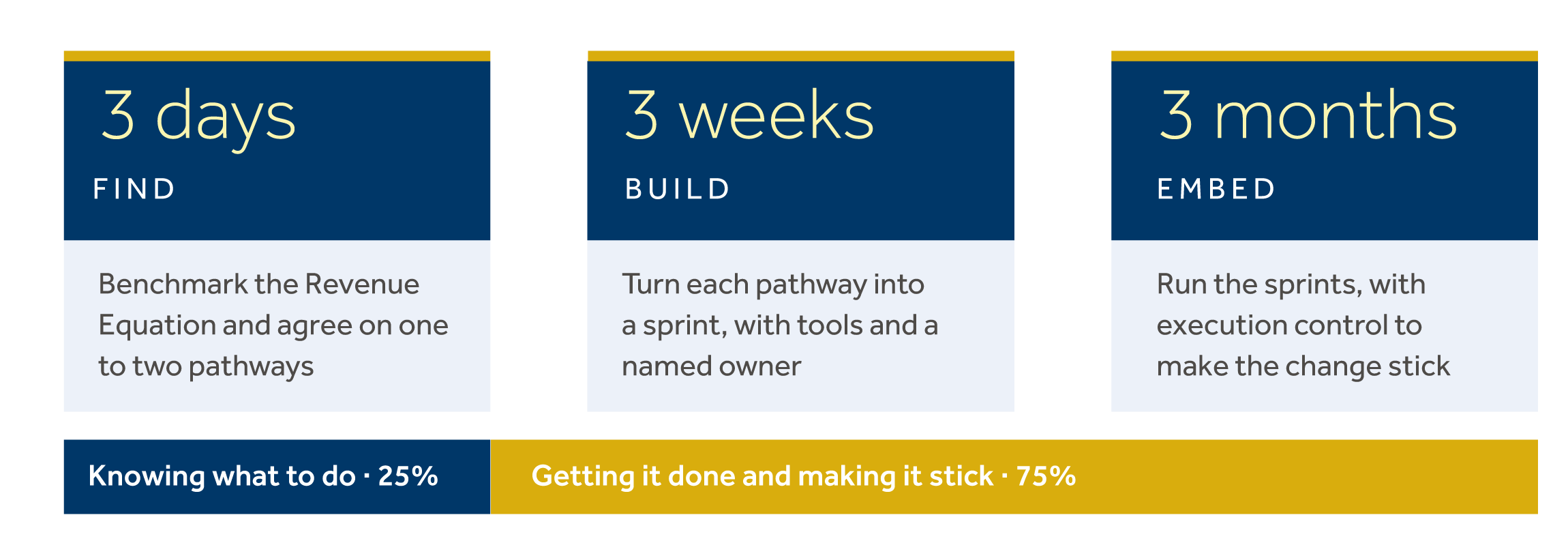
We built our own approach around this idea and call it the 3-3-3 Revenue Accelerator Program™. The first three days go to identifying the one to two pathways to growth, using diagnostics and benchmarks we already have. The next three weeks turn growth pathways into sprints based on the design guides, each with its own tools and a named owner. The following three months
are spent embedding the changes, with hands-on implementation support and what we call execution control. In practice, that means clear owners, a weekly operating rhythm, and agreed-upon impact/activity metrics, along with a monthly commercial review at the steering committee level to ensure focus and avoid drift. The time is weighted heavily toward execution, since that’s where most programs stall.
We also employ a technique called Execution Control to address a frequent complaint we hear from CROs. Their dashboards look backward. By the time they show a problem, the quarter’s over. In the weekly rhythm, Execution Control reviews the CRM and other systems on Monday and recommends the most valuable action for each rep. The manager approves or adjusts the action and the rep commits. On Friday the systems are checked again to see whether it happened. For many managers this is the first time they have been able to tell weekly whether the right things are getting done.
A platform company built through acquisitions used this approach for cross-sell. Its sellers had spent years making quota on inbound demand for the core product and had never been trained, or paid, to sell the acquired products. With no time before the exit to turn them into consultative sellers, the company used AI to cover the gaps while those skills developed. AI scored the accounts and drafted a plan for each one. It also reviewed calls and flagged opportunities the reps had missed.
Managers inspected the work weekly. Deal size rose 25% in the first quarter, and the company finished the year at 107% of its growth target.
6. Replicating Across the Portfolio
We see the role of operating partners taking two approaches, and many firms use some version of both.
One is a bespoke program at a few portfolio companies. The second is what we would call a commercial-engineer model, where an operating partner takes something that has worked at one company, such as a design guide or an AI workflow, and adapts it for other portfolio companies instead of rebuilding it. Each reuse makes the next one cheaper and easier to install, and that’s an advantage specific to a portfolio.
The operating partners we spoke with can see their role changing. “We’re moving from operating partner to product manager of a shared GTM-AI platform, or a commercial engineer,” one said. Another pointed to the gap that needs filling: “Humans are beginning to play an edge role in the go-to-market engine as opposed to a central role — that structural shift is coming and CROs may not be ready to lead, or operating partners support, an AI-first commercial model.”
The Revenue Equation identifies where the value is, and commercial engineering is the process of capturing it, first at one company and then at others. The work begins with the value creation plan and, ideally, is underwritten at the investment committee. AI allows it to move at private equity speed, and run as a fast moving sequence of sprints. Initiatives are only done once the behavior has changed and results realized.
7. Where to Start
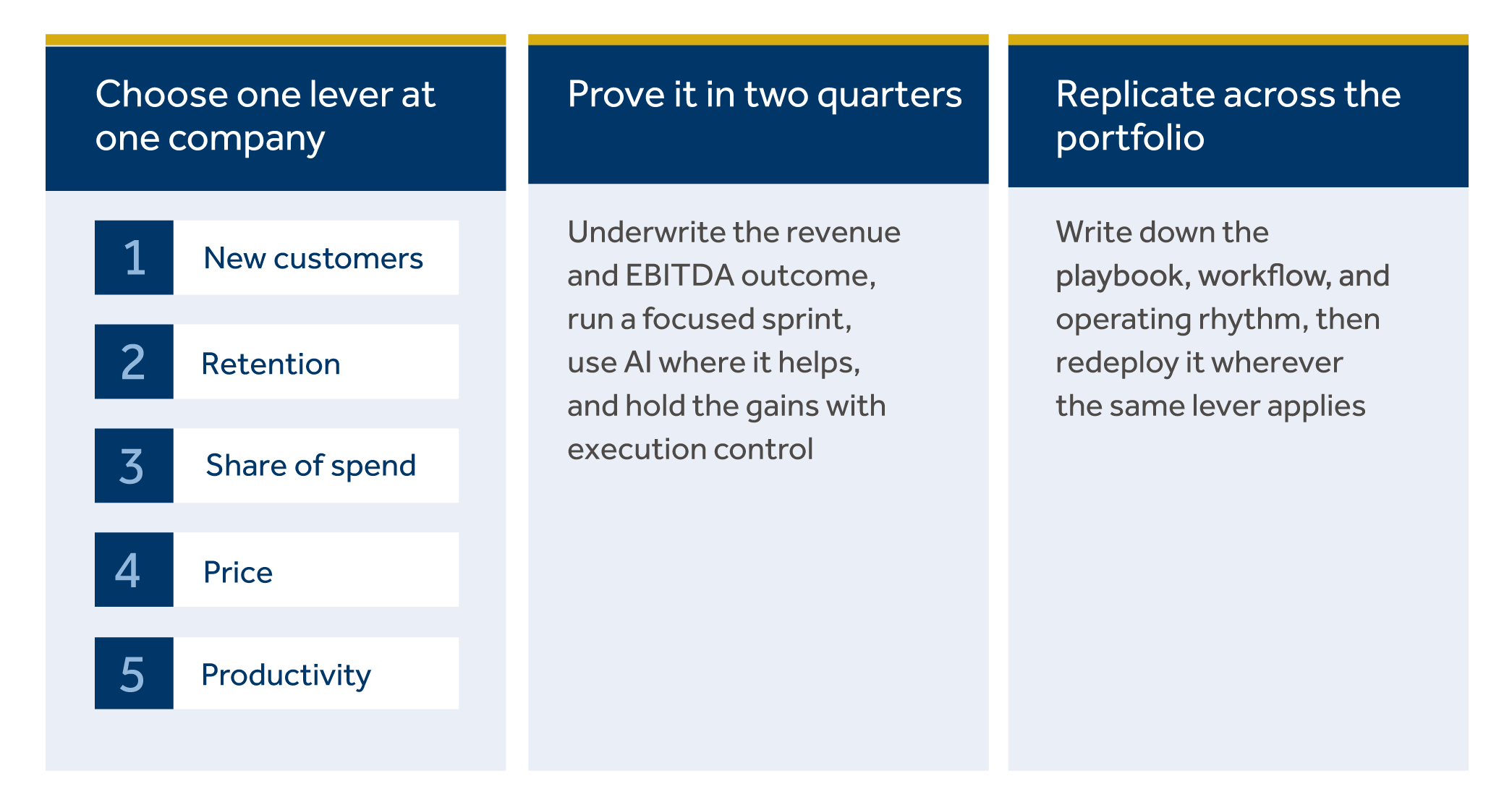
The first step can be modest. Choose one portfolio company, pick a single pathway (e.g., cross-selling), commit to one measurable
outcome and give it two quarters.
Be specific about the revenue and EBITDA impact at the start and run a focused sprint, using AI where it helps and Execution Control to keep it on track. Then, document what worked so it can be reused at the next company where the same lever applies.
In our experience, 500 to 1,500 basis points of growth is often already sitting inside these businesses, and many owners need to capture it soon for exit. While the fundamentals involved aren’t new, what has changed is that AI makes it possible to put them in place quickly enough to fit within a hold period, ensure that they’re working, and that your portfolio company is capturing the revenue growth and productivity benefits.
“Commercial engineering has the potential to turn one measurable commercial win into a reusable portfolio capability.”
Operating Partner
Want to see what’s working today? Request the full list of 120+ commercial AI use cases.