Professional Services Firms Have Been Losing Ground on Pricing Since 2023

What’s Behind It, and What to Do About It
Executive Summary
- Professional services firms have a pricing problem, and the numbers are quietly getting worse. Fewer than half have prices that are keeping pace with inflation, resulting in negative real growth from unit price realization year over year.
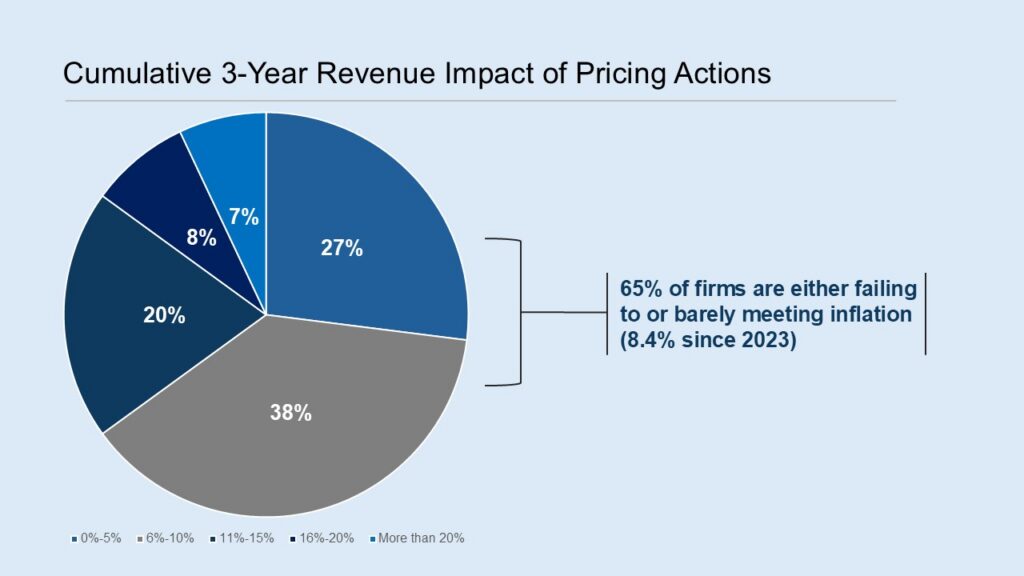
- A majority of firms have achieved less than 10% cumulative revenue growth through pricing from 2023-2025, at or below inflation over the same period.
- The constraint is not market conditions, but execution. The evidence suggests real pricing headroom exists across most subsectors.
- Firms that are succeeding have adopted a consistent set of pricing practices, including more structured offerings, tighter pricing discipline, and clearer monetization of value.
Most professional services firms are raising prices, but not enough to offset inflation. The gap between nominal price increases and real purchasing power is compounding quietly in the background. Inflation since 2023 has eroded roughly 8.4% of revenue in real terms for firms that held pricing flat. The constraint is not external; it is internal.
About the Survey
This analysis draws on a Blue Ridge Partners survey of 60 commercial leaders across the professional services sector, primarily in North America, conducted in April 2026. Respondents were predominantly C-suite and senior executives, spanning management consulting, technology and IT services, staffing, and accounting.
Why Have Firms Fallen Behind?
The natural assumption is that something in the market has changed: heightened client sensitivity to cost, increased competition, or the disruptive pressure of AI on service delivery. The data does not support these explanations.
It’s Not AI (at least, not yet)
Most service firms report no change to average contract size due to AI, and almost as many firms report an increase in average contract size as a decrease. If AI were compressing pricing, the data would look materially different.
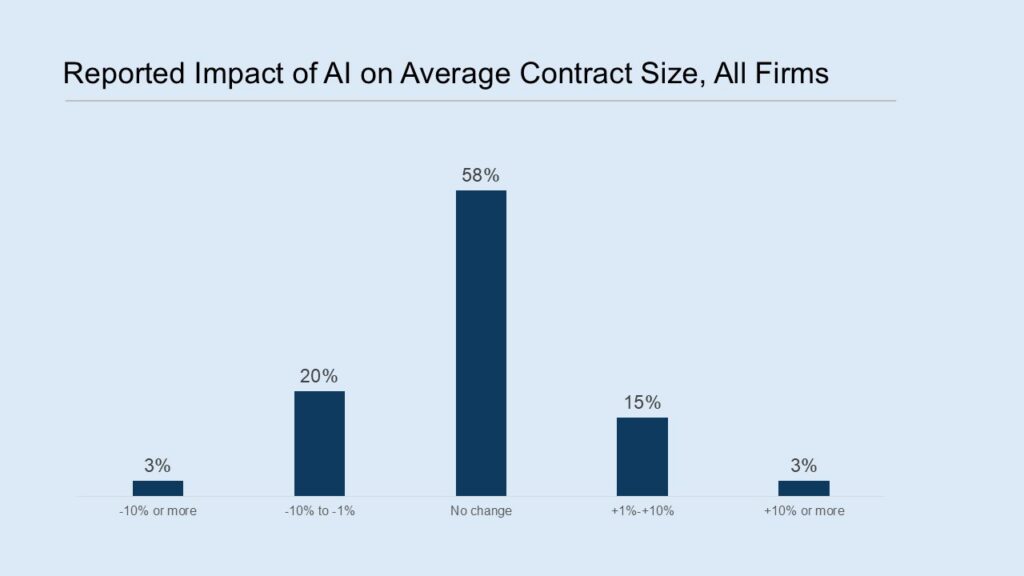
While many professional services leaders cite AI as a potential source of pricing pressure, the anticipated impact has not yet materialized in the data. Firms that have been deferring pricing action due to AI uncertainty are effectively waiting for a headwind that has not yet arrived. This topic is explored further in our upcoming work on pricing in the age of AI.
It’s Not Client Resistance
Evidence of pricing headroom across most subsectors suggests that client resistance is not the binding constraint. If buyers were consistently pushing back on price increases above inflation, we would expect to see a ceiling effect, with high-performing firms clustered just below a resistance threshold. Instead, pricing leaders are pulling away from the pack, with 35% of firms posting gains of 11% or greater, and 15% of firms attaining increases of more than 16%. This indicates that when value is clearly communicated and offerings are well-structured, buyers are willing to pay.
The Real Cause: Outdated Pricing Models
Our research points to a more structural explanation. Old pricing models, built around time-and-materials billing and undifferentiated service offerings are running out of steam. Firms with these pricing models face a difficult choice: raise rates and risk appearing expensive, or absorb cost inflation and accept margin compression. Many have been defaulting to the latter, consciously or not.
A second driver is pricing dispersion. Our research shows that pricing leaders are much more likely to price similar contracts within a tight range (<10% variance). Laggard firms are not just pricing too low on average; they are pricing inconsistently, leaving pockets of underpriced work that drag down realized revenue even when list prices appear adequate.
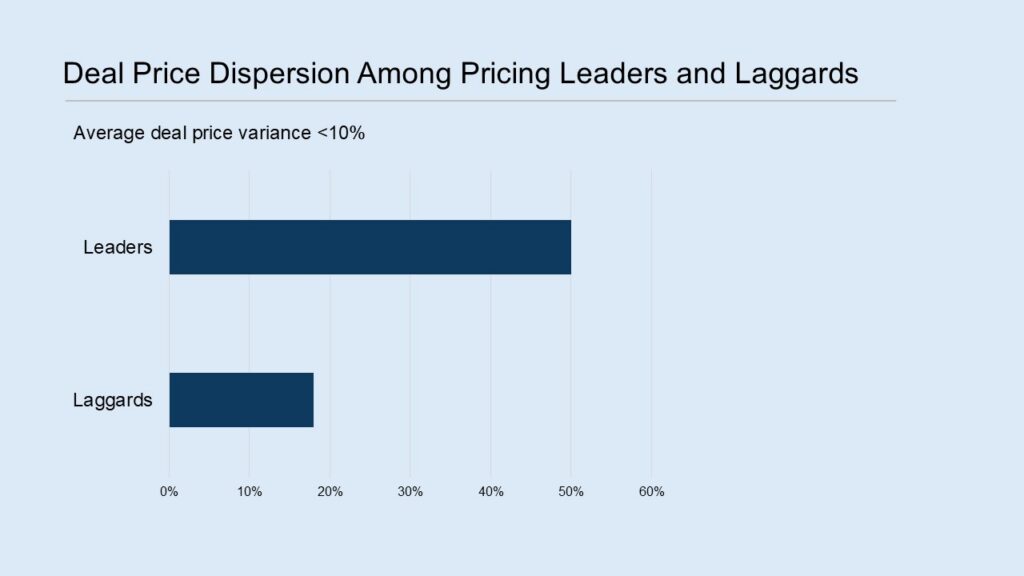
Discount controls alone do not solve this. Leaders and laggards emphasize discount controls at similar rates, yet leaders achieve far greater consistency. The difference is structural: leaders build consistency into their pricing architecture by design, through productized offerings and tiered packaging that reduce the surface area for discretionary discounting. Laggards try to manage dispersion through governance alone, and it does not work.
Four Things Pricing Leaders Do Differently
The firms that are succeeding share four distinguishing practices. None of these practices is novel in isolation, but their combination, and the discipline with which leaders execute them, set a clear path for firms that are falling behind.
- Productize core offerings: Derive >50% of revenue from standardized, repeatable services
- Use tiered packaging: Deploy good-better-best (or similar) structures to anchor value and upsell
- Monetize IP explicitly: Charge directly for data, tools, and methodologies
- Standardize across acquisitions: Integrate pricing and packaging post-M&A to unlock synergies
1. Productize your core offerings
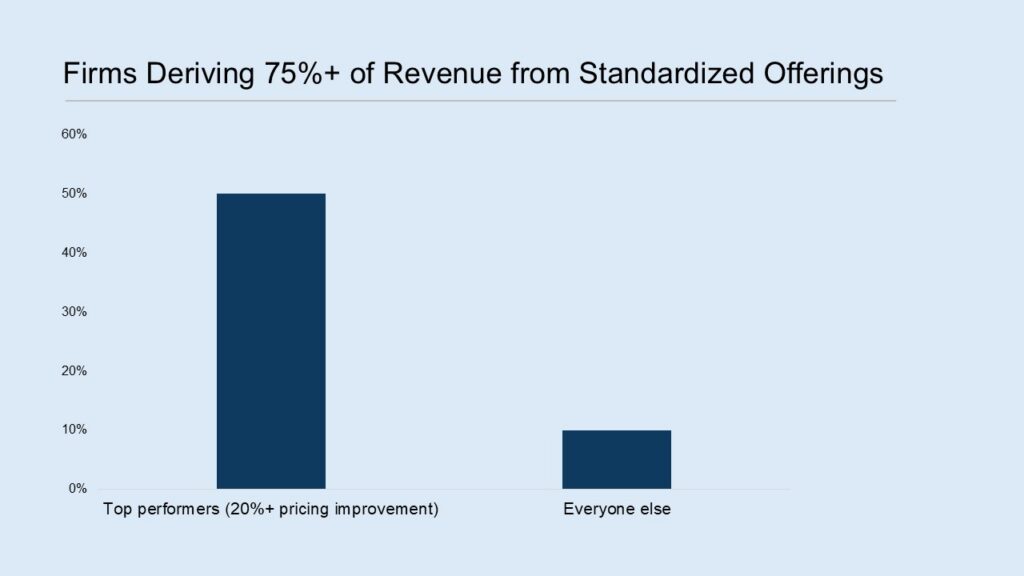
Top performers are nearly 5x more likely than average to derive more than 75% of revenue from standardized offerings. This enables consistent pricing execution, clearer buyer communication, and scalability across teams, and is also an effective mechanism for limiting price dispersion.
Services businesses often think of their offerings as bespoke and project-based, but this is not inherently at odds with productization. A better-defined “service shelf” simplifies value communication and deal negotiation, typically leading to shorter sales cycles as well as better pricing outcomes.
2. Create offering tiers
Going a step beyond basic productization, more than 20% of leaders use tiered offerings, such as standard delivery packages with slimmer or more fulsome deliverables, while adoption among laggards is nearly zero. Tiering anchors price expectations, clarifies incremental value, and creates built-in upsell pathways.
While not yet widespread in professional services, the adoption of service tiering is emerging as a powerful way to calibrate pricing to client needs and willingness to pay, and to clearly align price to value within a negotiation.
3. Charge for intellectual property
Combining effort and expertise under one pricing metric has always been problematic. Pricing leaders are far more likely to charge explicitly for access to IP such as proprietary data or tooling. And these are not small charges: more than half of leaders report that IP-related fees account for more than 15% of contract revenue, with a frontrunner reporting values above 30%.
Bundling IP into delivery masks value. Separating and pricing it unlocks it, both in terms of revenue capture and in terms of client perception of what they are buying.
4. Harmonize pricing across acquisitions
Nearly 80% of pricing leaders report that, across the acquisitions they have made, pricing is now highly standardized. This is not accidental; it reflects a deliberate priority to treat post-M&A integration as a pricing opportunity.
Integration is a natural inflection point to reset bad historical practices and ensure that the acquiring firm’s pricing standards are not contaminated by newly acquired habits. Instituting a clear post-M&A pricing playbook is a high-return investment for firms that grow through acquisition.
What to Do: A Starting Point for Firms That Have Fallen Behind
For firms that recognize themselves in the laggard profile: below-inflation price realization, wide pricing dispersion, sole reliance on effort-based billing, unstructured offerings; the good news is that the path forward is well-defined. The practices described above are not proprietary to a handful of firms; they are learnable and executable.
We recommend the following initial steps to begin building a pricing capability that can generate sustained real revenue growth:
- Audit recent deal pricing to identify comparable deals and understand your true level of price dispersion.
- Build on those findings to develop the contours of a productization strategy. Can offerings be standardized without sacrificing client value?
- Inventory your assets to determine what IP, including data, tools, and methodologies, can be explicitly monetized.
- Assess your competitive position, particularly with respect to your overall price-to-value perception, the value of your IP, and your impact on business outcomes.
- Launch a structured pricing improvement program: stand up the team, define the roadmap, and commit the resources to execute.
The firms that act on these steps will find that pricing is not a constraint on growth; it is one of the most powerful levers available. Those that wait will find the inflation gap compounding quietly year after year.
Leading organizations treat pricing as a core commercial capability, one that is designed, embedded, and continuously improved. This is the focus of Blue Ridge Partners’ pricing practice: helping organizations accelerate revenue growth by building the structures and capabilities required to execute pricing consistently.