Q4 2026

Finding the Money: How to Unlock 5% to 15% of Trapped Growth

After more than 25 years of working with over 1,300 companies, Blue Ridge Partners has found that nearly every organization has 500–1,500 basis points of organic growth trapped within its commercial organization. The opportunity is significant—but identifying where growth is being lost and determining how to capture it requires a disciplined, data-driven approach.
The starting point is understanding the company’s revenue equation: the nine levers that can accelerate organic growth. These include opportunities across pricing, cross-selling, new-customer acquisition, retention, sales productivity, and more. The challenge is determining which levers offer the greatest potential for each business. We call this finding the money.
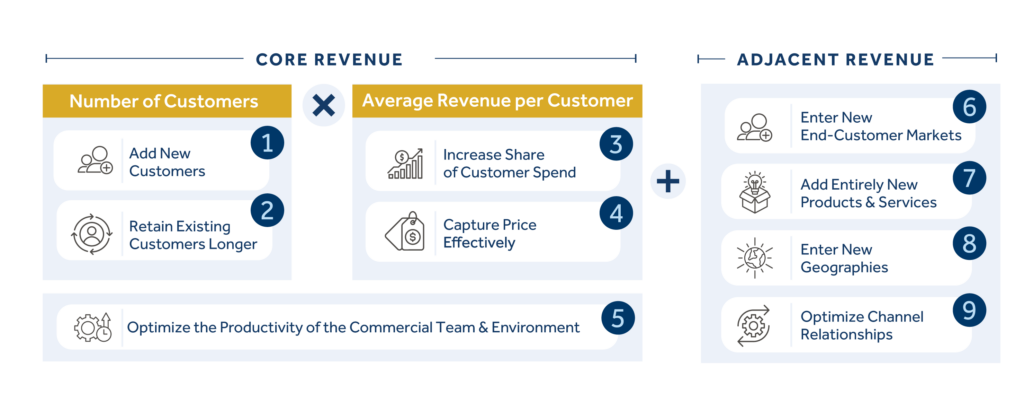
That means gathering the right performance metrics for each growth lever, comparing results against relevant benchmarks, identifying performance gaps, and quantifying the potential financial impact. With a clear view of the opportunity, leadership can prioritize the highest-value initiatives and develop a targeted action plan to capture them.
But identifying the right opportunities is only part of the equation. Knowing which levers to pull accounts for roughly 25% of the challenge; execution accounts for the other 75%. Companies need a practical blueprint for translating insight into action, addressing the process, talent, organizational, and technology barriers that can prevent results.
To bridge that gap, Blue Ridge Partners has developed Revenue Design Guides for each component of the revenue equation. These guides outline the process changes, common pitfalls and solutions, relevant AI applications, and organizational and talent requirements needed to improve performance. Focused 3-3-3 sprints help translate these insights into action, establish accountability, and accelerate measurable results.
The approach follows a simple timeline: three days to find the money, three weeks to design the solution, and three months to capture it. Rather than relying on broad transformation programs that can take years to deliver impact, the 3-3-3 approach focuses on identifying the highest-potential opportunities and moving quickly to realize their value.
For CEOs, CFOs, and commercial leaders, the opportunity is to look beyond incremental improvement and uncover the growth already within reach—then build the execution discipline to turn that potential into revenue and profit.
Nearly every company has untapped growth potential within its commercial organization. Discover where that value is hiding and how to capture it in Unlocking 5–15% of Trapped Growth in the Commercial Organization.
Start with the Fundamentals to Get More from AI

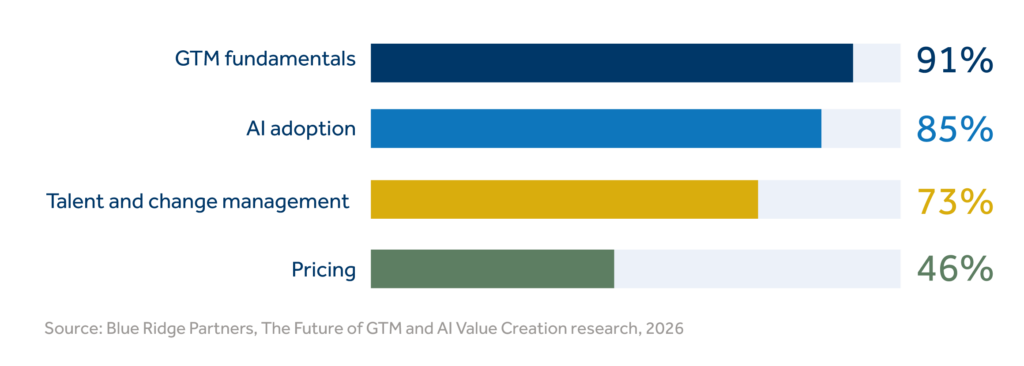
AI is creating significant opportunities for private equity firms to accelerate value creation, but not every investment is delivering the expected returns. To understand what is working and where investments are falling short, Blue Ridge Partners conducted one-on-one interviews with 72 Operating Partners about their experiences implementing AI across portfolio companies.
One finding stood out: when fundamental commercial processes and systems are broken, layering advanced AI on top is unlikely to deliver meaningful value. AI can help clean and organize data, but it cannot compensate for a fundamentally flawed go-to-market model. Before pursuing sophisticated applications, companies need to establish the processes, data quality, and operating discipline that allow AI to deliver results.
The interviews reinforced the importance of getting the basics right. 91% of Operating Partners identified go-to-market fundamentals as a primary focus of value creation, with most seeing opportunities to strengthen these capabilities across their portfolios. Applying AI to improve core commercial processes has emerged as one of the most effective starting points—and a prerequisite for more advanced applications that can drive measurable financial impact.
Once those fundamentals are in place, more sophisticated AI applications can unlock additional value. Operating Partners highlighted several use cases delivering tangible returns, including AI agents that automate prospecting, lead qualification, and follow-up; cross-portfolio playbooks to improve lifetime value relative to customer acquisition cost (LTV); real-time ROI modeling that helps sales teams strengthen their negotiating position; and organizational redesign that combines human judgment with AI capabilities.
For private equity firms, the opportunity is not simply to deploy more AI. It is to identify where technology can address the most consequential commercial constraints, prioritize investments based on their potential financial impact, and move quickly from experimentation to measurable results.
Blue Ridge Partners’ 3-3-3 Revenue Accelerator™ is designed to do exactly that. Through a focused, rapid-cycle approach, the program identifies high-potential opportunities in three days, develops targeted interventions in three weeks, and drives value realization over three months.
Find out how to turn AI and commercial opportunities into measurable value creation. Explore the 3-3-3 Revenue Accelerator™ and discover how to unlock trapped growth across your portfolio.
The 2027 Pricing Outlook

As companies prepare their 2027 budgets, pricing remains one of the most direct levers for protecting margins and driving profitable growth. For the fifth consecutive year, Blue Ridge Partners surveyed company CXOs to understand their pricing plans, expectations, and priorities for the year ahead.
Despite supply chain disruptions in the Middle East and continued uncertainty surrounding AI, 2026 price increases delivered strong results: just 7% of companies reported unsuccessful outcomes. Looking ahead, executives are planning median price increases of 4–5% in 2027, with relatively little variation across sectors, company sizes, and geographies. Meanwhile, 50–60% of companies across industries plan to undertake significant pricing optimization initiatives next year.
The data reveal important differences by industry and potential gaps between pricing plans, rising costs, and the value companies are capturing.
Software companies are projecting 12% revenue growth in 2027, up from 7% in the prior year’s survey, and planning median price increases of 5%. Yet only 1% report fully monetizing AI functionality in their products, and just 25% have an AI pricing enablement program for their sales teams. As AI reshapes product capabilities and customer expectations, monetization remains a significant opportunity. For a deeper look at how to capture the value of AI-driven products, read our whitepaper, The Five Keys to AI Pricing, which explores how to align pricing strategy with evolving AI capabilities and customer value.
Business services firms expect 8% revenue growth and median price increases of 5%, slightly below their anticipated 5.4% increase in variable costs. AI is already changing the economics of delivery: firms report a 7% reduction in delivery costs in 2026 and expect that reduction to reach 17% by 2028. The challenge is ensuring these productivity gains translate into stronger profitability rather than simply being passed on to clients.
Industrial companies plan median price increases of 4%, below estimated cost-of-goods-sold increases of 5.5% in the US and 4.3% in Europe. For many manufacturers, this gap could put margin improvement at risk unless pricing strategies account for cost pressures, customer willingness to pay, and competitive dynamics.
Across all three sectors, the message is clear: setting a price increase is only the starting point. Companies must determine where and how to raise prices, understand customer value and willingness to pay, equip sales teams to communicate and defend pricing, and monitor execution to capture the intended results.
Blue Ridge Partners helps leadership teams develop pricing strategies tailored to their market and business economics and build the sales enablement and execution capabilities needed to turn those strategies into measurable financial results.
Get the data behind your 2027 pricing decisions. Read the full report, How to Budget for Your 2027 Price Increases, for industry benchmarks, executive expectations, and insights to inform your pricing strategy and budget.
Execution Control: Unlocking the Potential of the Middle 60%

In nearly every organization, significant revenue growth is trapped in plain sight; not in the market, the product, or the strategy, but within the existing sales team. Blue Ridge Partners’ experience across more than 1,300 company engagements points to a substantial opportunity in the middle 60% of sales representatives: capable sellers who consistently underperform their potential. Unlocking that opportunity can deliver more than 600 basis points of growth.
In most sales organizations, the top 20% of reps carry a disproportionate share of revenue growth, while the bottom 20% consume valuable management time despite persistently weak performance. The middle 60% represent the greatest untapped opportunity as these sellers have the potential to deliver more, but they lack the focus, skills, coaching, and incentives needed to perform at their best.
The causes are often systemic. Reps waste time on low-value activities and unqualified leads, while struggling to communicate value to buyers, losing deals they could have won. Inadequate coaching and misaligned incentives reinforce mediocre performance rather than drive improvement. The biggest obstacle is often the front-line sales management model itself. Too many organizations promote top sellers into management roles without equipping them to lead, coach, and develop a team. Managers become consumed by forecasting and closing large deals to hit quarterly targets instead of improving the performance of every rep. Without the right tools, clear weekly priorities, and accountability mechanisms, they cannot consistently translate strategy into results. That, combined with misaligned management incentives, only compounds the problem.
The solution is not another round of generic sales training. It requires an integrated approach to sales execution that strengthens front-line management, teaches reps to sell value and prioritize their time, aligns incentives with desired behaviors, and removes internal friction that makes selling unnecessarily difficult. It also means identifying what the top performers do differently. From engaging the right decision-makers to executing effective sales plays, making those practices repeatable across the team is a key strategy for sales effectiveness.
Based on our work with more than 1,300 companies, Blue Ridge Partners helps organizations build the systems and management discipline needed to improve sales productivity. The objective is tangible: increase quota attainment by 10 percentage points for each rep in the middle 60%, unlocking meaningful revenue growth without relying solely on additional headcount or new-market expansion.
Through Execution Control for Commercial Organizations, Blue Ridge Partners takes a structured approach: assess current performance and execution gaps in one week, design an improved operating model over the next three weeks, and implement, monitor, and refine it over three months. The result is a more disciplined sales organization in which managers coach effectively, reps focus on the right opportunities, and performance improvement becomes measurable.
Want to understand why sales execution breaks down—and how front-line managers can turn strategy into results? Read Why Strategy Execution Fails in Sales Organizations—and How Sales Managers Drive Results to learn how stronger sales management can unlock your team’s full revenue potential.
Marketing in an AI World

B2B marketing has undergone a fundamental transformation. In the 1980s, marketing primarily supported sales. The 1990s and 2000s brought websites and email, expanding digital reach and creating new ways to engage buyers. The 2010s ushered in marketing automation and demand generation, making it possible to scale campaigns and measure their impact. Today, AI is reshaping how buyers discover, evaluate, and select providers, and fundamentally changing how companies must compete for growth.
Buyers now complete much of their purchasing journey before ever speaking with a sales representative. Decisions involve larger buying committees, more independent research, and increasingly AI-mediated discovery. Intent data, first-party data strategies, and AI-driven content and personalization are becoming essential tools. At the same time, marketing, sales, and customer success are converging under unified Revenue Operations (RevOps) models, with shared accountability for metrics such as pipeline velocity, customer acquisition cost (CAC) payback, and net revenue retention.
Yet many marketing organizations are struggling to keep pace. The role, skill sets, technology, and operating models required for success have evolved faster than many organizations can adapt, indicating that the entire commercial model must evolve. Sales cycles may begin with a product demonstration or a highly targeted RFP response rather than traditional discovery. Sellers must shift toward solution engineering and technical advisory, potentially requiring changes to compensation plans. Coverage models must account for AI-mediated entry points and changing buyer behavior. Lead generation and demand-generation investments must move further upstream to influence buyers before they enter an active purchasing process. Meanwhile, pricing strategy and transparency face greater scrutiny as buyers use AI to compare offerings, evaluate alternatives, and challenge value propositions.
These shifts are interconnected. Changing one part of the revenue engine without understanding its impact on the others can create friction, disrupt execution, and undermine growth. Leaders need a comprehensive view of how marketing, sales, pricing, customer success, and commercial operations work together and how to redesign the model to reflect today’s buying environment.
The opportunity is bigger than modernizing marketing. It is about rethinking how the entire commercial organization generates, captures, and sustains profitable growth.
How is AI changing the way your customers buy? Explore The AI-Augmented Buyer: 6 Structural Shifts Reshaping B2B Buying to understand the forces reshaping buyer behavior and what they mean for your commercial strategy.
Stay Ahead of What’s Working in Go-to-Market and Pricing
The Revenue Brief is Blue Ridge Partners’ quarterly perspective on the strategies, insights, and proven approaches helping companies accelerate profitable growth. Look for future editions featuring fresh research, practical guidance, and lessons from the field on what’s working across go-to-market and pricing.