Building a Sales Pipeline: 4 Strategies High-Growth SaaS Companies Use to Win
In SaaS, building a sales pipeline is the primary driver of revenue growth. Yet despite heavy investment in demand generation, most companies struggle to convert activity into predictable growth.
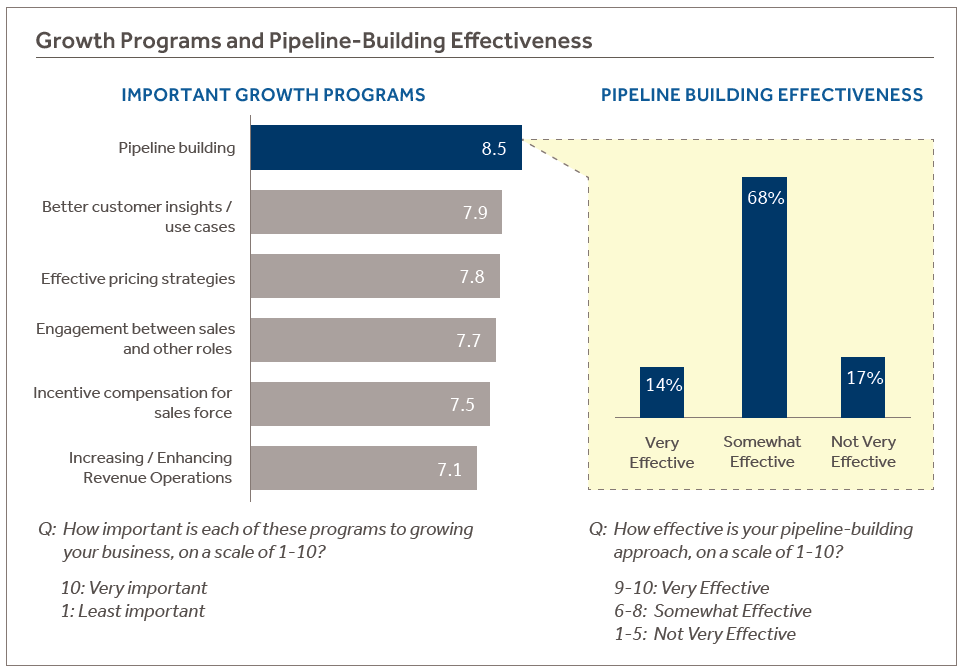
In our survey of 76 SaaS commercial leaders, only 14 percent rated their pipeline-building efforts as highly effective. The majority described their approach as only somewhat effective, and nearly one in five admitted it was not very effective.
The difference between high-growth and low-growth companies is not effort. It is the discipline behind how pipeline is built, qualified, and converted.
Why Sales Pipeline Efforts Fall Short
Many SaaS organizations miss growth targets because their pipeline-building process breaks down early. Weak lead generation, inconsistent qualification standards, poor marketing-sales alignment, and underutilized technology all contribute to underperformance.
Survey results show:
- 68 percent rate pipeline-building as only somewhat effective
- 17 percent describe their efforts as not very effective
- Only a small minority have built a scalable, repeatable pipeline engine
Pipeline problems rarely appear in isolation. They compound over time, affecting bookings predictability, revenue velocity, and investor confidence.
What High-Growth SaaS Companies Do Differently
We identified a clear performance gap between two groups:
High Growers, achieving 35 percent revenue growth
Low Growers, growing at just 8 percent
High Growers consistently outperform in several key areas:
- They invest approximately 45 percent of revenue in sales and marketing, compared to 30 percent for Low Growers
- They allocate a larger share of spend toward marketing to strengthen early-stage pipeline
- They expect 34 percent revenue growth in 2025, compared to 11 percent for Low Growers
This disciplined investment approach strengthens both pipeline volume and pipeline quality.
What a Strong SaaS Sales Pipeline Actually Includes
A strong sales pipeline is not simply a list of open opportunities. In high-performing SaaS organizations, pipeline is a measurable commercial system built to generate predictable revenue.
A scalable pipeline typically includes:
- Defined target segments and ICP clarity, ensuring demand generation is focused on accounts that convert and retain
- Consistent qualification standards, so pipeline reflects real buying intent rather than inflated activity
- Pipeline coverage discipline, including a clear pipeline-to-bookings target by segment and channel
- Stage-level conversion management, with clear expectations for conversion rates and cycle time at each funnel step
- Sales and marketing alignment, including shared definitions of qualified leads and structured handoffs
- Pipeline inspection and forecasting rigor, so leadership can diagnose weaknesses early rather than react late
High-growth SaaS companies treat pipeline quality as a leading indicator of future performance. Low-growth companies often treat it as a lagging report.
Four Strategies High-Growth SaaS Companies Use
High Growers do not rely on tactics alone. They apply structured discipline across four dimensions.
1. Maintain a 3–4X Pipeline-to-Bookings Ratio
Most High Growers target a 3–4X pipeline-to-bookings ratio. This ensures adequate coverage without inflating low-quality opportunities.
The goal is not simply more pipeline. It is the right pipeline.
2. Invest Adequately in Lead Generation
Under-resourced SDR and BDR teams are a common constraint. High Growers fund early-stage demand generation deliberately, recognizing that pipeline strength begins upstream.
They treat lead generation as a growth investment, not an expense line.
3. Prioritize Early-Stage Pipeline Quality
Volume without qualification drives inefficiency. High Growers align marketing and sales around clearly defined target segments and qualification criteria.
Better segmentation and disciplined qualification increase conversion rates downstream.
4. Use Technology and AI to Improve Pipeline Quality and Conversion
High-growth SaaS companies use technology to strengthen pipeline discipline, not just automate activity.
They deploy predictive targeting and intent data to prioritize the right accounts. They use AI-driven lead scoring to improve qualification. They monitor CRM hygiene to ensure pipeline data reflects reality. And they use pipeline inspection tools to diagnose stage-level conversion gaps before they become revenue shortfalls.
Technology does not replace process. It sharpens it.
Low-growth companies often invest in tools but fail to integrate them into a structured commercial system. As a result, automation increases activity without improving conversion or predictability.
Five Actions to Strengthen Your Sales Pipeline Now
To improve pipeline performance, SaaS leaders should focus on the following actions:
- Concentrate sales efforts on highest-value target segments using updated market models. Identifying expansion opportunities through a structured cross-selling strategy.
- Evaluate lead-generation capacity and address resource gaps
- Conduct detailed lead attribution analysis to understand conversion drivers
- Formalize marketing-to-sales handoffs with defined qualification criteria and service-level agreements
- Elevate pipeline reporting to the executive level, tracking metrics such as pipeline-to-bookings ratio, lead conversion rates, pipeline velocity, and lead-generation productivity
Pipeline improvement requires focus, not complexity.
Why Pipeline Discipline Drives Predictable Growth
In competitive SaaS markets, generating leads is not enough. Sustainable growth depends on the ability to build, track, and convert a high-quality sales pipeline consistently.
Companies that master pipeline discipline create greater revenue predictability, stronger capital efficiency, and improved operating leverage.
Building a better sales pipeline is not about activity. It is about structured execution aligned to growth objectives.
To learn more about how leading SaaS organizations are strengthening pipeline performance, download the full brief.