The Lost Years, 10 Years On
What Private Equity Has Learned About Revenue Growth—and What It Still Gets Wrong

Executive Summary
Ten years ago, we wrote The Lost Years to describe a pattern we were seeing repeatedly in private equity investments. Although revenue growth was often the largest source of value creation in the investment thesis, many sponsors delayed meaningful growth initiatives until well into the hold period. The resulting loss of time was difficult, and often impossible, to recover.
A decade later, the industry has changed considerably. Operating models are more sophisticated, formal value creation plans are standard, commercial diligence is deeper, and operating teams bring significantly greater functional expertise. Fewer firms simply wait to address growth.
Yet lost years have not disappeared. The nature of the problem has changed.
What Was True Then and Why It Mattered
In 2016, the reasons for delay were understandable. Cost reduction appeared more controllable and produced results that were easier to measure. Revenue growth was inherently more complex, dependent on customer behavior, sales execution, pricing discipline, commercial leadership, competitive dynamics, and often a series of interdependent organizational changes.
There was also an important management dynamic. Many CEOs had limited experience leading significant commercial transformation, while sponsors were understandably cautious about intervening too aggressively at the beginning of a new ownership period. Challenging a company’s growth plan immediately after close could be interpreted as questioning management’s capability before the working relationship had fully developed.
Consequently, management’s initial growth plan — typically sound in direction but incomplete in execution specifics — was frequently given time to develop before sponsors intervened more actively.
The economic consequence was significant. Growth initiatives that could have begun in year one were delayed until year two or three. By then, the remaining hold period was shorter, and the opportunity to compound early revenue and EBITDA improvement had been permanently reduced. Revenue generated earlier in the hold contributes to the earnings base in every subsequent year. Revenue that is delayed cannot be recreated by accelerating faster later.
Progress, and a More Subtle Problem
Private equity firms deserve considerable credit for what has changed. Most sophisticated sponsors now enter investments with a formal value creation plan. Commercial diligence is used to test important elements of the growth thesis. Operating partners with meaningful functional experience are involved earlier.
Management teams are more accustomed to working jointly with sponsors on value creation initiatives. These changes have materially reduced the wholesale delay we observed ten years ago. The more common problem today is creeping delay – important initiatives deferred just long enough to affect the economics of the investment – combined with the impact of longer holds and evolving market conditions.
Reporting and governance may take priority during the first several months. Management may expect pipeline performance to improve without significant intervention. A commercial initiative may wait for the arrival of a new CRO. A new coverage model may be postponed while another organizational issue is addressed. A strategic growth vector identified during diligence may receive further study before meaningful resources are committed.
Each decision may be reasonable on its own. Collectively, they can consume six to twelve months of a hold period. The industry has become much better at identifying growth opportunities early. However, management teams do not always act on them early enough.
The Continuing Cost of Creeping Delay
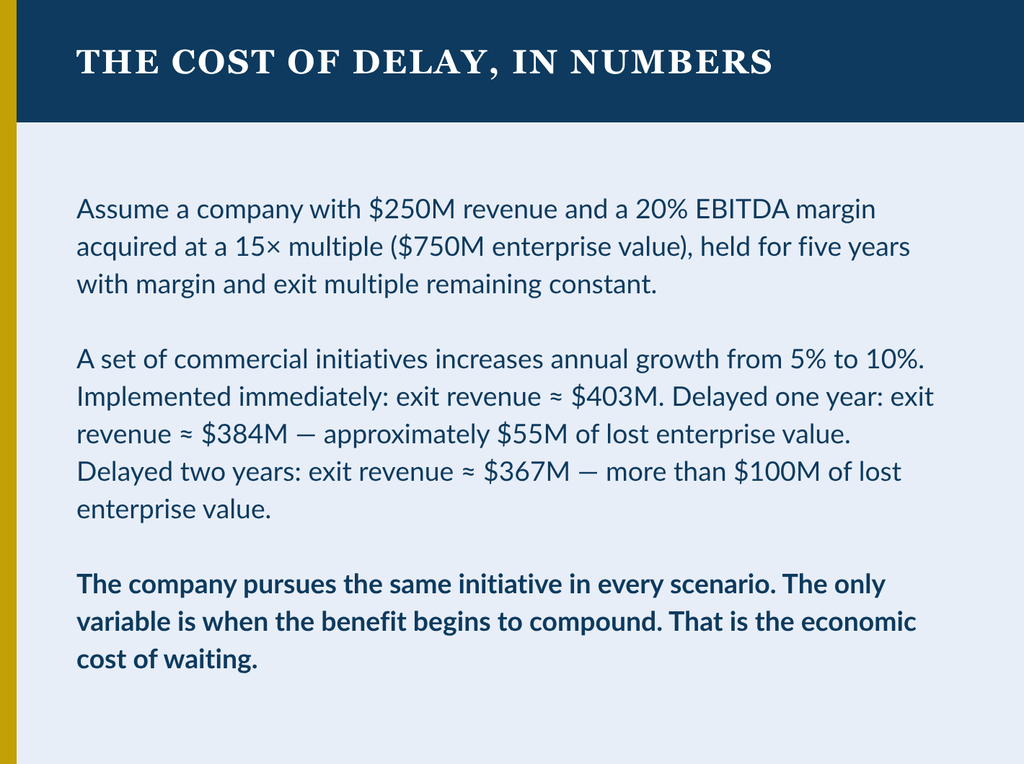
Time is not economically neutral. Consider an initiative capable of improving annual growth from 5% to 10%. If implementation begins immediately, the higher growth rate contributes to the revenue base in every subsequent year. If the same initiative begins one year later, the company does not merely lose incremental revenue from the first year; rather, every following year’s growth begins from a lower base.
This is why a six- or twelve-month delay can have consequences at exit far larger than the revenue deferred during the initial period. The issue is particularly acute today: multiple expansion cannot be assumed, financing costs remain meaningful, and buyers increasingly expect evidence that growth is durable and transferable. Under those conditions, the timing of revenue improvement matters almost as much as its ultimate magnitude.
Why Waiting Still Happens
The reasons sponsors wait today are not fundamentally different from the reasons they waited ten years ago. There remains a legitimate desire to establish an effective working relationship with management, avoid disrupting the sales organization unnecessarily, and allow new commercial leadership to assess the business before significant changes are made.
In other cases, the company simply has too many priorities. Value creation plans have become more comprehensive, and a portfolio company may be pursuing pricing, sales effectiveness, customer retention, new products, channel development, geographic expansion, and technology improvements simultaneously. None of these considerations should be dismissed. The question is whether they justify delaying the specific growth initiatives with the greatest potential to affect value during the hold period.
Three patterns appear with particular regularity:
- Leadership Deference: A legitimate caution about intervening too early can persist beyond the point at which evidence of a capability or execution gap has already emerged.
- Initiative Diffusion: When every growth lever carries roughly equal weight, organizations struggle to determine what comes first, and energy disperses across too many workstreams for any of them to build real momentum.
- Complexity as Cover: Genuine operational complexity can make delay feel inevitable when it is not. Integrating an acquisition, redesigning a coverage model, or restructuring a sales organization all create real dependencies. The important question is not whether those dependencies exist, but whether they are truly preventing action or providing organizational cover for postponement.
The discipline required is not indiscriminate speed. It is deciding early which initiatives warrant immediate action, which require additional proof, and which can appropriately wait — and then executing the plan.
From “Can It Grow?” to “Will It Grow Fast Enough?”
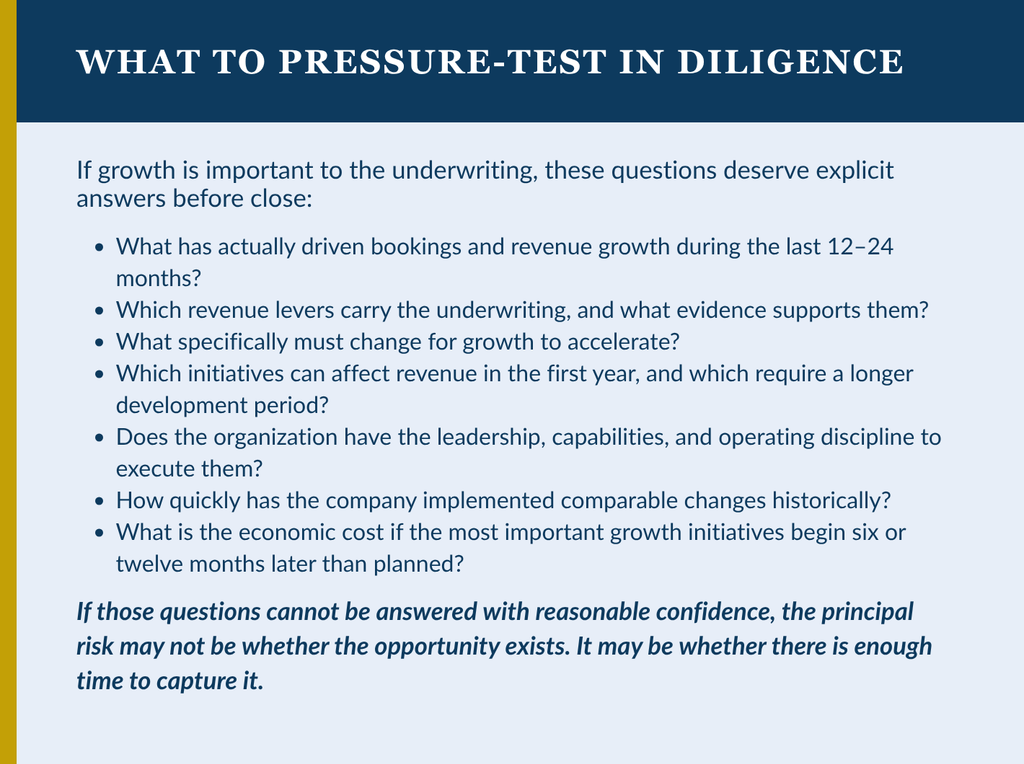
Commercial diligence has become significantly more sophisticated. It can provide a strong fact base on market attractiveness, customer behavior, competitive position, pricing opportunity, and sales performance. But it can still stop one step short of what management needs after close.
Too often, diligence establishes that an opportunity exists without determining what must change operationally to capture it, how quickly that change can occur, and which actions should come first. Management then spends the first several months of ownership converting diligence findings into an executable plan. That period is an important source of today’s creeping delay.
Traditional commercial diligence appropriately asks whether the growth assumptions supporting the investment are credible. For many investments, an equally important question is whether the growth will occur soon enough to create the expected value.
It also requires separating different types of growth. Some initiatives can affect performance relatively quickly: pricing improvement, account prioritization, sales coverage adjustments, targeted retention actions, focused improvements in conversion. Others inherently require more time: new product development, new geographic markets, major channel expansion, significant changes in commercial capability.
Both can be appropriate components of a value creation plan. The mistake is treating them as though they have the same timing profile. The relevant question is not simply whether the growth plan is achievable. It is whether the mix and sequencing of initiatives will generate sufficient improvement during the period in which the sponsor owns the business.
A more actionable diligence process should clarify where growth is currently constrained, which revenue levers are most important to the underwriting, what must change to improve performance, how long those changes are likely to take, and whether the organization has the leadership and operating capability to execute them. When that work is done well, management can begin the ownership period with a clear set of priorities rather than spending the first several quarters rediscovering issues that were already visible during diligence.
The CEO’s Role — Then and Now
Ten years ago, many CEOs had limited experience with significant commercial transformation. That remains true in many industries, but the challenge has become more complicated. In PE-to-PE transactions, the incoming owner often inherits a business in which the most obvious sources of core growth have already been addressed. The value creation plan may depend on growth vectors — new products, new markets, revised coverage models, cross-selling — that were introduced late in the prior ownership period and remain only partially proven. Also, a VCP created for a 4-5-year hold period may have deprioritized important growth initiatives that could be successfully launched with today’s longer holds, enabling step-change improvements that drive significant value creation.
Scaling those initiatives requires new capabilities, different operating cadences, and more explicit execution priorities. This places a premium on early clarity about what can produce near-term improvement and what requires longer-term investment.
That requires greater attention to the leading indicators of commercial performance. Recent bookings momentum, pipeline quality and conversion, pricing discipline, customer retention, sales productivity, commercial leadership depth, and the organization’s historical ability to execute change can all provide evidence about how quickly growth can realistically accelerate.
An early, fact-based view of commercial opportunities, the likely timing of their impact, and the areas where execution capability may need to be strengthened allows the CEO and sponsor to make explicit choices about sequencing rather than allowing timing to be determined by organizational inertia.
Avoiding the Lost Years in 2026
Avoiding lost years today does not require a fundamentally new private equity operating model. It requires greater discipline around priorities, timing, and execution. Revenue planning should begin before close rather than after a period of stabilization. Growth assumptions should be decomposed into the specific commercial levers required to produce them. Initiatives should be evaluated not only on potential value, but also on time to impact and organizational readiness. The cost of delay should be made explicit when assessing priorities. And revenue improvement should be managed with the same fact-based rigor routinely applied to cost initiatives. The objective is to ensure that the initiatives most important to the investment thesis do not lose six or twelve months simply because the organization has not made an explicit decision about timing.
We have found it effective to identify the most critical levers for “moving the needle” on growth at the very beginning of the hold period (“where’s the money?”) and then execute a series of highly focused, short duration sprints to capture the opportunity. This approach attacks one of the most common sources of delay – the fear of long, expensive projects that don’t achieve their planned results within the hold period. Focused, shorter-duration initiatives can produce early results while limiting organizational disruption and preserving resources for longer-term growth priorities.
Conclusion
Ten years ago, lost years were often the result of a relatively simple problem: sponsors recognized the importance of growth but waited too long to address it. The industry has made substantial progress. Growth is considered earlier, commercial diligence is better, operating capabilities are stronger, and sponsors are more willing to engage on revenue performance.
The remaining problem is more nuanced. Sponsors can identify the correct growth priorities, incorporate them into the value creation plan, and still lose meaningful time before those priorities begin affecting performance.
Growth initiatives should be sequenced according to their economic importance, the time required to produce results, and the organization’s ability to execute them. The goal is not to do everything immediately. It is to avoid discovering, several years into an investment, that the initiatives most important to value creation should have started several quarters earlier.